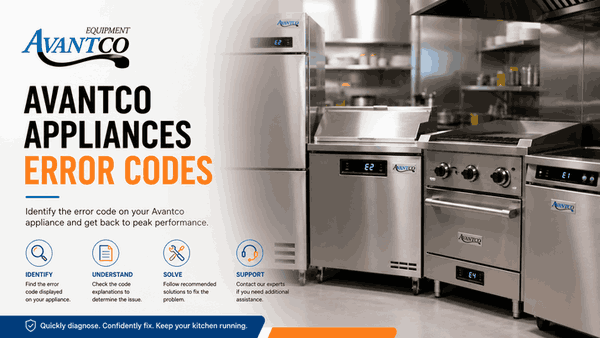
An Avantco error code is usually most useful when it is connected to the way the equipment is actually performing. The display may show only a short warning, but the real issue often appears in daily operation. A refrigerator may struggle to hold product temperature. A freezer may keep sounding alarms or lose stable cabinet conditions. A modular ice machine may stop making ice, interrupt harvest, or enter protection mode instead of running normally.
For customers in San Jose and across the Bay Area, these alerts are best understood as commercial equipment warnings tied to real operating performance, not final diagnoses. In many cases, the code does not identify one exact failed part by itself. Instead, it points to the system that is losing stability. That may involve temperature monitoring, sensing, control communication, water supply, refrigeration safety, or shutdown protection.
Many refrigeration problems begin before the unit fully stops. Equipment may still be running, but temperature control, ice production, or normal recovery is already changing. That is often when repeated alerts begin appearing.
A one-time code can sometimes follow a temporary interruption. A warning that keeps returning usually means more. In practical commercial use, repeated Avantco alerts often fall into a few larger patterns: temperature alarms, sensor trouble, communication faults, water-related issues, and refrigeration-system protection shutdowns. Once the same message keeps coming back, the main question becomes whether the equipment can still support normal kitchen, prep, or storage workflow.
For Avantco refrigerators, one of the most important groups is:
High Temp Alarm / Low Temp Alarm / E1 / E2 / rE / rsF / CHt / dor
These alerts usually point to high- or low-temperature alarm conditions, sensor faults, fan-related issues, cabinet heat problems, or a door condition that is affecting normal cooling. In daily commercial use, that may look like unstable product temperature, poor cabinet recovery, repeated alarms, or a refrigerator that no longer holds temperature normally.
For Avantco freezers, the main family is:
HI / LO / E01
These warnings usually point to a cabinet probe high-temperature alarm, a low-temperature alarm, or a communication failure. In real use, that may show up as unstable freezer conditions, repeated alarm activity, or a freezer that no longer performs the way the operation expects.
What links these refrigerator and freezer warnings together is temperature reliability. The unit may still have power, but once cabinet conditions stop staying stable, the warning is already affecting product protection.
For Avantco modular ice machines, the main family here is:
E00 / E11 / E01 / E02 / E03 / E04 / E05 / E06 / E07 / E08 / E09 / E10 / E12 / E13
These alerts usually point to refrigeration-system failure, water curtain or ice-full switch problems, ice-making overtime, harvest overtime, high system temperature, water shortage, overpressure, condenser temperature-sensor faults, water temperature-sensor issues, water-level control trouble, or pump-related problems.
In commercial use, that may mean no ice production, interrupted harvest cycles, repeated shutdowns, or a machine that enters protection mode to prevent further damage. What makes these warnings important is the operating impact. An ice machine problem is rarely just about the display. It affects output, timing, and service readiness.
The best first step is to compare the code with what the equipment is actually doing.
If the refrigerator is running warm, the freezer is holding unstable temperature, or the ice machine is not producing, not harvesting, or shutting down repeatedly, the equipment is already showing the real context behind the warning.
A repeated Avantco alert usually means more than a brief interruption. It often shows that one of the unit’s key systems is losing stability and that normal commercial use is already being affected.
Avantco error codes are most useful when they are treated as early signs of changing equipment dependability. They may not identify the exact failed component by themselves, but they often show which function is under stress and whether the unit can still be trusted in real operation.
For customers in San Jose and throughout the Bay Area, professional commercial service can help connect the recurring code to the actual symptom, identify why the warning keeps returning, and determine the next repair step.
📍 Address: 919 S Winchester Blvd, San Jose, CA 95128
📧 Email: office@bestechrepair.com
☎️ Phone: (408) 906-8668
This Avantco commercial error code table organizes each Avantco fault code by equipment type, listed meaning, initial check, technician service note, and related help when available. It includes Avantco commercial refrigerators, freezers, prep units, display refrigeration, bar refrigeration, specialty refrigeration, and ice machines, so each display message can be matched with the correct table row and reviewed with Avantco Refrigeration’s official Support Resources.
| Error Code | Appliance | Meaning | Safe first steps | Technician required | Related help |
|---|---|---|---|---|---|
| High Temp Alarm | Refrigerator | Cabinet temperature is above the high-temperature setpoint / safety threshold. | Verify door closure, airflow, condenser cleanliness, product load, and evaporator-fan operation. If the evaporator is iced, run the official manual-defrost procedure and let the cabinet recover. | Yes - if the alarm does not clear after the official airflow / cleanliness / defrost checks. | |
| Low Temp Alarm | Refrigerator | Cabinet temperature is below the low-temperature setpoint. | Verify actual cabinet temperature against setpoint and check whether the control is driving the refrigeration system too long. | Yes - if the cabinet remains too cold or the control appears stuck running. | |
| dor | Refrigerator | Door-open alarm. On Z Series units, the display shows dor after the door has been left ajar for about 15 minutes. | Close the door, verify the gasket seals, and inspect hinge / alignment or door-switch issues if the display does not clear. | Yes - if the door is fully closed and the alarm remains active. | |
| LO | Chillers & Freezers | Cabinet probe low temperature alarm (temperature under -49F / -45C). | Press START/STOP to start refrigeration and recheck cabinet temperature after about 2 hours. If LO remains, inspect the cabinet temperature probe and related devices for fault. | Yes - if LO remains after the official restart and recheck. | |
| E03 | Modular Ice Machines | Ice harvest overtime (protective shutdown). | Clean scale from the evaporator, verify ice thickness setting, and test whether the ice-full sensor / proximity switch is sensing the harvest correctly. If restart does not produce ice, continue with inlet, drain-valve, and refrigerant checks. | Yes - if harvest timing does not normalize after cleaning and sensor checks. | |
| E04 | Modular Ice Machines | High system temperature fault (protective shutdown). | Verify the cooling fan runs freely and is not stuck, then clean the air filter net or condenser. | Yes - if cooling airflow is correct and the system still overheats. | |
| E05 | Modular Ice Machines | Water shortage fault (protective shutdown). | Verify incoming water supply / pressure and filter condition. If the tank overflows, inspect the water-level sensor. Also test the water inlet valve. | Yes - if supply is normal but the machine still reports water shortage. |
Read reviews about our repair, installation and maintenance services. Our trained experts are always ready to help. To schedule your next appointment, give us a call or complete our online form.

Leave your contact details for communication with the operator, indicate a convenient date for yourself and our operators will contact you or call us: