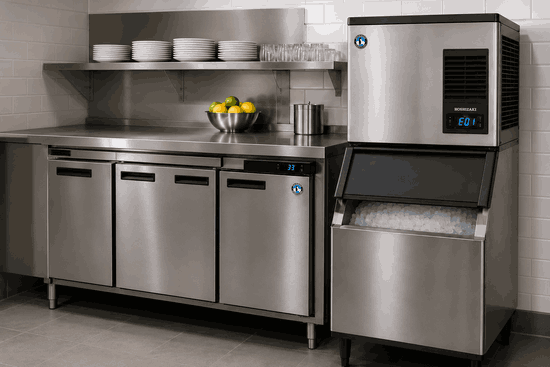
A Hoshizaki IM-200 high evaporator temperature issue usually means the ice machine is detecting that the evaporator is not reaching or holding the expected temperature during the ice-making sequence. Staff may notice slow ice production, thin or incomplete cubes, long freeze cycles, harvest delays, repeated alarms, or a machine that runs but does not produce enough ice.
For San Jose restaurants, bars, cafés, hotels, offices, and food-service spaces, this problem should be treated as an ice-production reliability warning. The IM-200 depends on stable water flow, evaporator heat transfer, condenser airflow, fan response, compressor operation, sensor feedback, and controller timing. If the evaporator temperature stays too high, the machine may not freeze water efficiently.
The evaporator is the part of the ice machine where heat is removed so water can freeze into ice. During a normal freeze cycle, the evaporator should get cold enough for ice to form within the expected timing range.
If the evaporator temperature remains high, the controller may see that the machine is not removing heat properly. That can happen because of water-side problems, airflow restriction, dirty condenser conditions, weak refrigeration performance, temperature sensor issues, or control feedback faults.
Staff may first notice reduced ice output. The bin may refill slowly, cubes may look thin or uneven, or the machine may seem to run longer than usual without completing a batch.
The problem may become worse during hot kitchen conditions, heavy demand, poor ventilation, or after long periods without cleaning. In some cases, the machine may alarm quickly. In others, it may continue producing some ice while the evaporator temperature fault returns repeatedly.
A high evaporator temperature condition can begin on the water side. Low water level, restricted water flow, scale buildup, weak pump operation, or uneven water distribution can reduce freezing efficiency and make the evaporator appear unable to pull temperature down correctly.
Heat-removal problems are different. Poor condenser airflow, blocked ventilation, weak fan operation, compressor stress, refrigerant concerns, sensor faults, wiring issues, or controller problems can prevent the ice machine from removing heat from the system properly.
The key question is whether the machine has a water-circulation problem, an airflow problem, or a refrigeration/control problem affecting evaporator performance.
Staff can safely observe whether the ice machine has clear airflow around it, whether the bin is already full, and whether the room around the unit is unusually warm. Check whether ice production has slowed gradually or stopped suddenly.
Look for visible signs such as unusual ice shape, weak water movement, repeated alarms, or changes after cleaning, high demand, or hot weather. Record the alarm timing, batch behavior, room conditions, and whether the machine eventually produces ice.
Do not remove panels, test wiring, access refrigeration components, handle refrigerant lines, adjust internal controls, force harvest cycles, or use sharp tools to clear ice or scale.
A high evaporator temperature fault can reduce daily ice output and increase stress on the ice machine. If the machine keeps running without freezing properly, the compressor, fan, pump, and controls may work harder while production remains unreliable.
Resetting the unit may temporarily restart operation, but it will not repair scale restriction, weak water circulation, poor condenser airflow, sensor problems, compressor stress, refrigerant issues, or controller faults. If the alarm returns, the pattern needs proper diagnosis.
Bestech Repair checks the issue as a complete ice-making and heat-transfer sequence. A technician can evaluate water flow, pump response, evaporator freezing pattern, scale impact, condenser airflow, fan operation, compressor behavior, temperature sensor feedback, wiring condition, harvest transition, and control-board response.
The goal is to determine whether the Hoshizaki IM-200 high evaporator temperature issue comes from water restriction, cleaning or scale conditions, airflow limitations, sensor feedback errors, refrigeration performance, or a control-system fault.
A Hoshizaki IM-200 with a high evaporator temperature alarm can affect beverage service, prep routines, catering output, and daily ice availability. Bestech Repair provides Hoshizaki ice machine repair in San Jose for high evaporator temperature faults, slow ice production, long freeze cycles, incomplete cubes, airflow problems, water-flow issues, sensor faults, compressor concerns, and control-board symptoms.
A Hoshizaki IM-200 high evaporator temperature problem may be caused by low water flow, scale buildup, weak pump response, poor condenser airflow, warm surroundings, fan problems, sensor faults, compressor stress, refrigerant concerns, sealed-system restrictions, wiring issues, or electronic control failure. Staff can safely observe ice output, cube shape, airflow clearance, alarm timing, water behavior, and whether the problem changes during high-demand periods. If the alarm returns or ice production stays weak, professional diagnosis is the safer next step.
Bestech Repair – San Jose, CA
📍 Address: 919 S Winchester Blvd, San Jose, CA 95128
📧 Email: office@bestechrepair.com
📞 Phone: +1-408-906-8668
🕒 Open Hours: Monday – Sunday: 8:00 AM – 8:00 PM.
Read reviews about our repair, installation and maintenance services. Our trained experts are always ready to help. To schedule your next appointment, give us a call or complete our online form.

Leave your contact details for communication with the operator, indicate a convenient date for yourself and our operators will contact you or call us: