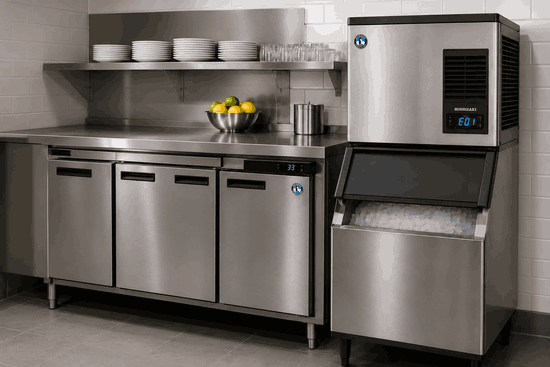
A Hoshizaki KM high voltage alarm usually means the ice machine is detecting an electrical condition outside the range it expects for safe, stable operation. Staff may see a voltage-related warning, repeated shutdowns, failed starts, interrupted freeze cycles, or an ice machine that resets but does not stay reliable.
For San Jose restaurants, bars, cafés, hotels, offices, and food-service spaces, this alarm should be treated as an equipment-protection issue. A Hoshizaki KM ice machine depends on stable incoming power, control-board response, compressor operation, fan performance, pump timing, and sensor feedback. If voltage is too high or unstable, the machine may stop to protect internal components.
A commercial ice machine uses electrical power to run the compressor, water pump, fan motor, controls, valves, and safety circuits. The controller expects power conditions to stay within a usable range.
When a high voltage alarm appears, the machine may be reacting to incoming power irregularity, control-board voltage feedback, damaged wiring, relay problems, compressor load issues, or an electrical supply problem outside the ice machine. The alarm does not automatically mean one part has failed, but it does mean the unit is seeing a condition that can affect safe operation.
Staff may notice the ice machine shuts down during startup, stops during freeze, or alarms after a power event. The unit may restart and run briefly, then return to the same warning. Ice output may drop because the machine cannot complete enough cycles.
The problem may appear after electrical work, storm activity, breaker issues, equipment sharing the same circuit, or heavy kitchen load. If the alarm returns at similar times of day, the building’s power conditions or connected equipment load may be part of the pattern.
Some high voltage alarms are related to the electrical supply. A dedicated circuit problem, loose supply condition, unstable voltage, breaker-panel issue, or nearby equipment causing power changes can affect the machine.
Repair-level ice machine causes are different. These may include control-board faults, relay problems, wiring issues, compressor electrical stress, fan motor issues, transformer concerns, or internal protection-circuit faults. Because these involve electrical components, staff should not attempt internal testing.
The key question is whether the alarm follows building power behavior or appears because the ice machine itself is failing under load.
Staff can safely record when the alarm appears, whether it happens at startup or during a cycle, and whether other kitchen equipment shows power problems at the same time. Note whether lights flicker, breakers trip, or the alarm started after electrical work or a power outage.
Check only visible operating conditions. Make sure the ice machine has proper ventilation clearance and is not overheating from blocked airflow or nearby heat sources. Confirm whether ice production stops completely or only becomes inconsistent.
Do not remove panels, test voltage, reset breakers repeatedly, access wiring, inspect the control board, touch internal electrical parts, or continue forcing restarts if the alarm returns.
Resetting a Hoshizaki KM ice machine may clear the alarm temporarily, but it will not correct unstable power, wiring faults, control-board issues, compressor electrical stress, or internal voltage protection problems.
Repeated starts can place additional strain on electrical components and make the original failure pattern harder to read. If the machine shuts down again, stop relying on resets and document the timing of the alarm.
Bestech Repair checks the alarm as a full electrical-protection and operating-load sequence. A technician can evaluate power response, control-board behavior, relay operation, compressor start behavior, fan motor load, wiring condition, ventilation influence, and whether the warning appears during startup, freeze, harvest, or standby.
The goal is to determine whether the Hoshizaki KM high voltage alarm comes from building-side power irregularity, equipment load conditions, control-board feedback, wiring failure, motor stress, or another internal electrical fault.
A Hoshizaki KM ice machine with a high voltage alarm can interrupt beverage service, prep work, and daily ice availability. Bestech Repair provides Hoshizaki ice machine repair in San Jose for voltage alarms, shutdown problems, failed starts, control-board symptoms, compressor concerns, fan motor faults, wiring issues, and ice production failures.
A Hoshizaki KM high voltage alarm may be caused by unstable incoming power, building electrical issues, equipment load changes, breaker-related problems, control-board faults, relay issues, wiring problems, compressor electrical stress, fan motor faults, ventilation-related overheating, or internal protection-circuit failure. Staff can safely observe alarm timing, restart behavior, visible airflow clearance, other equipment power symptoms, and whether the issue appears during startup or active ice production. If the alarm returns, professional diagnosis is the safer next step.
Bestech Repair – San Jose, CA
📍 Address: 919 S Winchester Blvd, San Jose, CA 95128
📧 Email: office@bestechrepair.com
📞 Phone: +1-408-906-8668
🕒 Open Hours: Monday – Sunday: 8:00 AM – 8:00 PM.
Read reviews about our repair, installation and maintenance services. Our trained experts are always ready to help. To schedule your next appointment, give us a call or complete our online form.

Leave your contact details for communication with the operator, indicate a convenient date for yourself and our operators will contact you or call us: