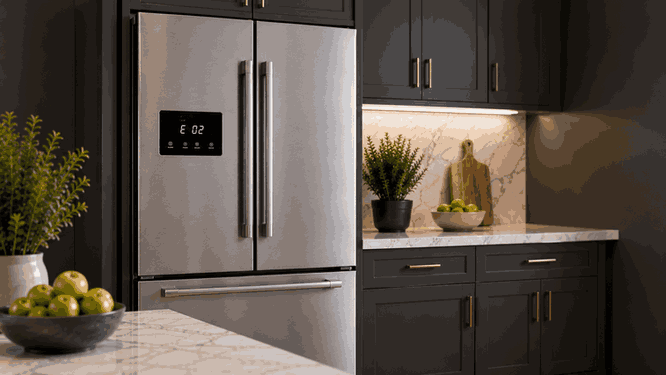
A Kenmore freezer not cold enough issue usually means the appliance still has power, but it cannot hold the selected freezing temperature. Frozen food may soften, ice may melt together, frost may appear near vents, or the freezer may run for long periods without reaching the correct range.
For San Jose homes, this problem should be checked quickly because freezer temperature affects food storage safety. The cause may involve door sealing, blocked airflow, fan operation, defrost behavior, temperature sensing, compressor response, condenser airflow, wiring, or electronic control timing.
A Kenmore freezer must produce cold air, move it evenly, and confirm the correct temperature through sensor feedback.
The freezer depends on the compressor, evaporator area, fan system, sensors, and control board to maintain stable freezing conditions. If cold air cannot circulate or the cooling system becomes weak, the cabinet may stay too warm even while the appliance appears to run.
A freezer can make normal sounds and still fail to freeze properly. Fan activity, lights, or display response do not always confirm that the compressor, defrost system, airflow path, or sensors are working correctly.
A Kenmore freezer not cold enough problem may appear suddenly after a power event or gradually as cooling performance declines.
Homeowners may notice:
Frozen food starts softening
Ice cubes melt together
Freezer temperature warning appears
Frost builds up near vents or panels
Fan sound changes or disappears
Compressor runs constantly or stays quiet
Door gasket looks loose or dirty
Temperature does not recover after several hours
If the freezer warms after heavy loading or frequent door openings, it may be trying to recover. If the temperature keeps rising or never stabilizes, the issue may involve airflow, fan response, defrost restriction, sensor feedback, compressor operation, or a sealed-system problem.
Not every weak-freezing issue starts with a failed compressor.
The door may not close fully because of food packaging, shelf position, ice buildup, or gasket debris. Interior vents may be blocked by tightly packed items. A recently loaded freezer may also need time to stabilize, especially if many room-temperature items were added at once.
A dirty or blocked condenser area can also make some freezers work harder and cool less effectively.
Repair-level causes may include an evaporator fan failure, faulty temperature sensor, defrost heater problem, compressor start issue, condenser fan fault, sealed-system concern, wiring problem, or control-board failure.
Heavy frost near vents or the back panel may suggest an airflow or defrost issue. A freezer that is warm with little compressor or fan activity may point toward control, sensor, fan, or cooling-system response.
Homeowners can review a few visible details without opening the appliance.
Confirm the selected freezer temperature. Make sure the door closes evenly and the gasket is not blocked, folded, dirty, or damaged. Check whether food is covering interior vents.
Listen for normal fan or compressor sounds after the door has been closed for several minutes. Note whether the freezer is slightly warm, fully thawing, or showing a warning.
Do not remove panels, test wiring, force door switches, chip ice with sharp tools, use heat tools inside the freezer, access internal cooling parts, or keep changing temperature settings without noting the original reading.
A freezer that stays too warm can quickly become a food-storage concern.
If the Kenmore freezer not cold enough issue continues and food is softening, protect stored items when possible. Repeated resets may change the display briefly, but they will not repair a fan, sensor, defrost, compressor, sealed-system, or control fault.
Bestech Repair checks whether the freezer is failing because of airflow, temperature feedback, defrost behavior, or cooling production.
A technician can evaluate door-seal contact, fan operation, airflow paths, temperature sensor response, defrost function, compressor activity, condenser airflow, wiring condition, sealed-system performance, and control-board communication.
The goal is to separate a loading, gasket, or blocked-vent issue from a Kenmore freezer fan, sensor, defrost, compressor, wiring, sealed-system, or electronic control fault.
A freezer that is not cold enough can affect frozen food, ice storage, and daily kitchen reliability. Bestech Repair provides Kenmore freezer repair in San Jose for weak cooling, warm freezer problems, temperature warnings, fan issues, defrost faults, compressor concerns, and airflow restrictions.
A Kenmore freezer not cold enough issue may be caused by blocked vents, poor door sealing, heavy loading, frequent door openings, dirty condenser conditions, frost buildup, failed fans, sensor faults, defrost problems, compressor trouble, wiring issues, sealed-system concerns, or control-board failure. Homeowners can safely check temperature settings, door closure, gasket condition, vent clearance, fan sounds, and whether food is softening. If the freezer does not recover, professional diagnosis is the safer next step.
Bestech Repair – San Jose, CA
📍 Address: 919 S Winchester Blvd, San Jose, CA 95128
📧 Email: office@bestechrepair.com
📞 Phone: +1-408-906-8668
🕒 Open Hours: Monday – Sunday: 8:00 AM – 8:00 PM.
Read reviews about our repair, installation and maintenance services. Our trained experts are always ready to help. To schedule your next appointment, give us a call or complete our online form.

Leave your contact details for communication with the operator, indicate a convenient date for yourself and our operators will contact you or call us: