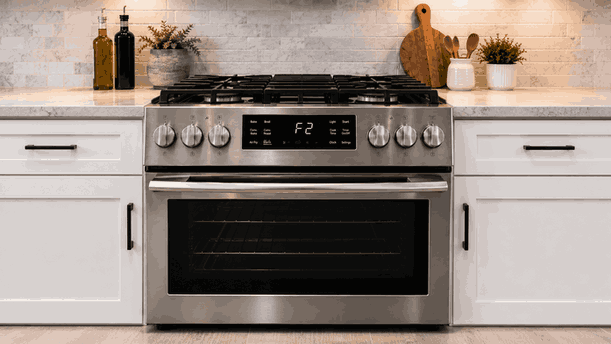
A KitchenAid range not working problem can mean several different things. The oven may not heat, the burners may not respond, the display may be blank, the controls may be locked, or the appliance may turn on but fail during cooking. Because a range combines cooking-surface controls, oven heating, sensors, safety features, and electronic communication, the exact failure pattern matters.
For San Jose homes, this issue should be checked by separating what still works from what does not. A range with one failed burner is different from a range with no display, no oven heat, or no response from any function.
The first clue is whether the entire KitchenAid range is dead or only one section has stopped working. If the display is blank and no cooking functions respond, the issue may involve power supply, control electronics, wiring, or a failed main control board.
If the display works but the oven does not heat, the problem may be in the bake element, broil element, igniter, temperature sensor, relay, or oven control circuit. If only the cooktop is affected, the issue may involve surface elements, burner switches, gas ignition, valves, modules, or control communication depending on the range type.
Before a KitchenAid range can cook correctly, it has to confirm user input, temperature demand, heating response, and safety conditions. Electric models rely on high-power circuits, elements, limiters, switches, relays, and sensors. Gas models also depend on ignition, flame response, gas delivery, and safety shutoff behavior.
When one part of that sequence fails, the appliance may appear “not working” even though some lights or controls still respond. That is why the symptom should be described by function: display, oven, burners, ignition, temperature control, or full power loss.
Some range problems begin with settings. Control lock, Sabbath mode, delayed start, timer confusion, or a misread cooking mode can make the appliance seem unresponsive. On some models, a locked control panel may prevent oven operation even though the display is still lit.
Repair-level faults are different. These may include failed heating elements, weak igniters, faulty burner switches, damaged sensors, broken relays, wiring problems, electronic control-board failure, power supply issues, or internal safety faults. If the appliance starts and then shuts down, clicks without heating, flashes errors, or loses heat during cooking, a deeper diagnostic check is usually needed.
Homeowners can safely confirm whether the display is on, whether the controls are locked, and whether the issue affects the oven, cooktop, or both. Check that the selected cooking mode is correct and that no delayed-start or special mode appears active.
For electric ranges, note whether one burner, all burners, or the oven has stopped heating. For gas ranges, note whether clicking occurs, whether burners ignite normally, and whether the oven responds at all.
Do not remove panels, test voltage, inspect internal wiring, bypass safety switches, adjust gas valves, access igniters, or keep forcing controls if the range behaves unpredictably.
If the KitchenAid range is gas and there is a strong gas smell that does not fade, stop using the appliance, ventilate the area, avoid flames or switches, and contact the proper gas emergency service before appliance repair.
A gas range that clicks repeatedly, fails to ignite, or shuts off during use should not be treated as a DIY adjustment. Ignition and gas-delivery problems need safe professional evaluation.
A range may seem usable when only one function fails, but repeated attempts can create more stress on controls, switches, heating parts, or ignition components. A burner that works sometimes, an oven that heats unevenly, or a display that resets during use can point to an intermittent fault.
If the range has burning smells, sparks, tripped breakers, visible damage, repeated error messages, no heat from multiple functions, or unexplained shutdowns, stop using the affected function and request service.
Bestech Repair checks the range by function instead of assuming one cause. A technician can evaluate control response, oven heating operation, cooktop behavior, sensor feedback, ignition performance, element response, wiring condition, relay output, and electronic control communication.
The goal is to identify whether the KitchenAid range not working issue comes from a simple setting, a single failed cooking zone, an oven heating fault, a gas ignition concern, a power delivery problem, or a broader control-system failure.
A KitchenAid range that stops working can interrupt daily cooking, meal prep, and kitchen routine. Bestech Repair provides KitchenAid range repair in San Jose for oven failures, burner problems, ignition issues, no-heat complaints, control-panel symptoms, sensor faults, wiring concerns, and electronic control-board problems.
A KitchenAid range may stop working because of control lock settings, mode selection issues, failed elements, weak igniters, burner switch faults, sensor problems, wiring issues, relay failure, power delivery trouble, gas ignition problems, or electronic control-board failure. Safe checks include confirming display response, control lock status, selected mode, and whether the oven, cooktop, or entire range is affected. If the range remains unresponsive, loses heat, smells unusual, sparks, or shows gas-related symptoms, professional diagnosis is the safer next step.
Bestech Repair – San Jose, CA
📍 Address: 919 S Winchester Blvd, San Jose, CA 95128
📧 Email: office@bestechrepair.com
📞 Phone: +1-408-906-8668
🕒 Open Hours: Monday – Sunday: 8:00 AM – 8:00 PM.
Read reviews about our repair, installation and maintenance services. Our trained experts are always ready to help. To schedule your next appointment, give us a call or complete our online form.

Leave your contact details for communication with the operator, indicate a convenient date for yourself and our operators will contact you or call us: