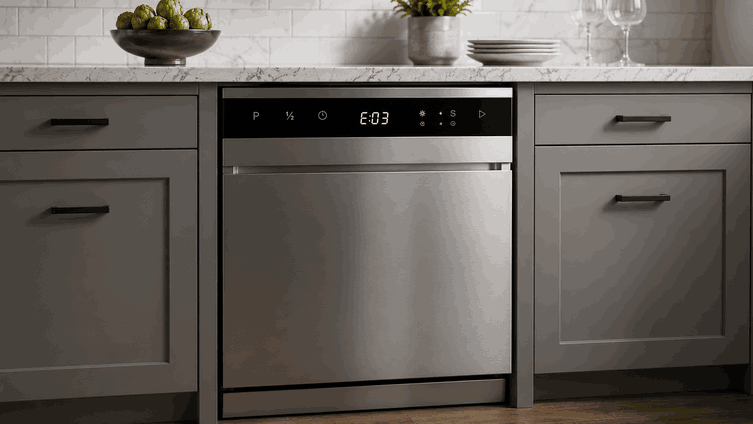
A Samsung dishwasher not cleaning dishes issue usually means the cycle finishes, but plates, glasses, utensils, or cookware still come out with food residue, greasy film, cloudy marks, or grit. The dishwasher may fill, drain, and sound normal, yet the wash result is weak or uneven.
For San Jose kitchens, this problem can make daily cleanup frustrating even when the appliance still runs. The cause may involve loading pattern, spray-arm movement, filter condition, water fill, circulation pressure, detergent release, heating response, sensor feedback, or electronic control timing.
A Samsung dishwasher needs the correct sequence of water, spray pressure, heat, detergent, filtration, rinse action, and drainage.
The wash motor must move water through the spray arms with enough pressure to reach both racks. If the spray path is blocked, circulation is weak, or the dishwasher does not fill correctly, dishes may remain dirty after a full cycle.
A completed program only means the control reached the end of the selected cycle. It does not guarantee that water temperature, spray movement, detergent release, or filtration worked properly during the wash.
A Samsung dishwasher not cleaning dishes problem may affect one rack, one type of dish, or the entire load.
Homeowners may notice:
Food particles left on plates
Grit or residue on glasses
Detergent still in the dispenser
Upper rack cleans worse than lower rack
Dishes feel greasy after the cycle
Spray arms do not seem to rotate
Cloudy film appears on glassware
Odor remains inside the tub
If only the upper rack is affected, the issue may involve spray-arm flow, rack position, or circulation pressure. If all dishes are dirty, the problem may involve low fill, weak wash motor response, poor heating, detergent release, clogged filters, or sensor feedback.
Not every cleaning problem means a major component has failed.
Overloading can block spray paths. Tall pans, bowls, cutting boards, or utensils may stop spray arms from spinning. A dirty filter area can allow debris to recirculate. Old detergent or a dispenser blocked by a large dish can also reduce cleaning performance.
Water temperature and cycle choice matter too. A quick or light cycle may not handle dried food, grease, or heavy soil as well as a longer wash program.
Repair-level causes may include a weak circulation pump, clogged spray arm, low water fill, inlet valve problem, failed heater, detergent dispenser fault, turbidity sensor issue, drain restriction, wiring problem, or control-board failure.
A dishwasher may fail to clean because it does not get enough water, does not spray strongly, does not heat, does not filter debris, or does not rinse correctly. Each cause needs a different repair path.
Homeowners can review a few visible items without opening the appliance.
Make sure dishes are not blocking the spray arms. Spin the spray arms gently only when the dishwasher is off and cool. Look for visible food debris around the filter area. If your Samsung model has a removable filter designed for user cleaning, clean it according to the normal instructions.
Check whether the detergent dispenser opens fully and is not blocked by cookware. Notice whether poor cleaning affects one rack, certain items, or the whole dishwasher.
Do not remove panels, test wiring, access the pump area, disconnect hoses under pressure, force spray arms, or use sharp tools to clear hidden passages.
Running the same load again may improve the result slightly, but it does not correct the cause of poor cleaning.
If the Samsung dishwasher not cleaning dishes issue continues after proper loading, visible filter checks, and correct detergent use, stop relying on extra cycles. Repeated washing can waste water, leave buildup, and make the original failure pattern harder to identify.
Bestech Repair checks which part of the wash sequence is not performing correctly.
A technician can evaluate fill level, circulation pressure, spray-arm movement, filter condition, heating response, detergent dispenser operation, drain behavior, sensor feedback, wiring condition, and control timing.
The goal is to separate a loading, detergent, or filter issue from a Samsung dishwasher pump, valve, heater, dispenser, sensor, wiring, or control-board fault.
A dishwasher that does not clean properly can leave kitchen cleanup unfinished and dishes unreliable for daily use. Bestech Repair provides Samsung dishwasher repair in San Jose for poor cleaning, weak spray, cloudy dishes, drain problems, fill issues, leaks, and cycle interruptions.
A Samsung dishwasher not cleaning dishes issue may be caused by poor loading, blocked spray paths, dirty filters, weak circulation, low fill level, detergent dispenser trouble, heating faults, sensor problems, drain restrictions, wiring issues, or control-board failure. Homeowners can safely check loading, spray-arm clearance, visible filter condition, detergent placement, and whether one rack or all dishes are affected. If dishes still come out dirty, professional diagnosis is the safer next step.
Bestech Repair – San Jose, CA
📍 Address: 919 S Winchester Blvd, San Jose, CA 95128
📧 Email: office@bestechrepair.com
📞 Phone: +1-408-906-8668
🕒 Open Hours: Monday – Sunday: 8:00 AM – 8:00 PM.
Read reviews about our repair, installation and maintenance services. Our trained experts are always ready to help. To schedule your next appointment, give us a call or complete our online form.

Leave your contact details for communication with the operator, indicate a convenient date for yourself and our operators will contact you or call us: