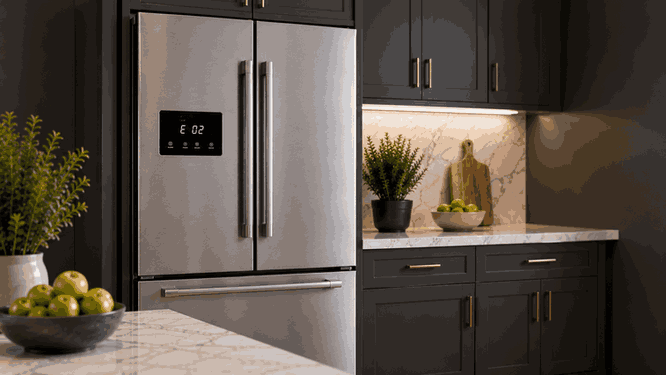
A Samsung refrigerator ice maker not working issue usually means the refrigerator still has power and cooling, but the ice system does not produce, release, or store ice correctly. The freezer may feel cold, the display may respond, and the water dispenser may still work, yet the ice bin remains empty, fills slowly, or develops clumped ice.
For San Jose homes, this problem can interrupt daily kitchen use even when the refrigerator appears mostly functional. The cause may involve freezer temperature, ice maker settings, water supply, filter condition, fill tube restriction, ice maker sensor feedback, fan operation, or electronic control timing.
A Samsung ice maker needs stable freezing conditions, water delivery, and correct harvest timing before it can produce ice.
The ice maker must confirm that the freezer or ice room is cold enough, water can enter the mold, and frozen cubes can release into the bin. If one part of this sequence fails, ice production may slow down or stop completely.
A refrigerator can seem cold while the ice maker still fails. Ice production depends on precise temperature, airflow, water flow, sensor response, and control communication, not just general cabinet cooling.
A Samsung refrigerator ice maker not working problem may develop gradually or stop suddenly after a filter change, temperature warning, power event, or ice buildup.
Homeowners may notice:
Ice bin stays empty
Ice production becomes very slow
Small, hollow, or misshapen cubes appear
Ice maker is on, but cubes do not drop
Ice clumps together in the bin
Water dispenser works, but ice does not
Ice room has frost or buildup
Error code or ice maker warning appears
If no water reaches the ice maker, the issue may involve the filter, water supply, inlet valve, or fill tube. If cubes freeze but do not release, the problem may involve the ice maker module, motor, sensor feedback, ice room temperature, or harvest cycle.
Not every no-ice issue starts with a failed ice maker assembly.
The ice maker may be turned off. The freezer temperature may be set too warm. The ice bin may be full, misaligned, or blocked by clumped ice. A clogged or overdue water filter can reduce water flow enough to affect ice production.
Samsung refrigerators can also be sensitive to ice room frost, door sealing, and airflow. Frequent door openings or a poor gasket seal can keep the ice maker from reaching stable production temperature.
Repair-level causes may include a failed water inlet valve, frozen fill tube, faulty ice maker assembly, bad ice level sensor, weak freezer fan, ice room air leak, defrost-related issue, wiring problem, or control-board failure.
If frost or ice buildup appears around the ice maker area, forcing parts or chipping ice can damage the assembly. The cause may involve air leakage, temperature control, defrost behavior, or water fill problems.
Homeowners can check a few visible items without opening the refrigerator or forcing ice maker parts.
Confirm the ice maker is turned on. Check the freezer temperature setting and make sure the freezer or refrigerator doors close fully. Look at the ice bin position and remove only loose, accessible ice clumps.
Check whether the water filter is overdue or was recently replaced. If your model has a dispenser, note whether water flow is normal, weak, or missing. Also note whether frost appears around the ice maker area.
Do not remove panels, test wiring, force the ice maker arm or tray, chip ice with sharp tools, use heat tools inside the freezer, or access internal water lines.
Turning the ice maker off and on may restart a cycle, but it will not fix weak water flow, poor freezer temperature, a frozen fill tube, sensor fault, fan issue, or control problem.
If the Samsung refrigerator ice maker not working issue continues after checking settings, bin position, door closure, filter status, and visible ice buildup, stop repeated resets. Repeated attempts can hide whether the issue is water-related, temperature-related, airflow-related, or control-related.
Bestech Repair checks whether the ice maker is failing to receive water, freeze properly, harvest cubes, or communicate with the refrigerator control.
A technician can evaluate freezer temperature, ice room condition, door-switch feedback, water supply behavior, filter restriction, inlet valve response, fill tube condition, ice maker module activity, fan operation, sensor feedback, and control communication.
The goal is to separate a setting, filter, bin-position, or visible ice buildup issue from a Samsung refrigerator valve, fill tube, ice maker assembly, sensor, fan, wiring, or control-board fault.
An ice maker that stops working can affect daily kitchen convenience even when the refrigerator still appears to cool. Bestech Repair provides Samsung refrigerator repair in San Jose for ice maker failures, no-ice problems, slow ice production, frost buildup, water supply issues, freezer temperature concerns, and control faults.
A Samsung refrigerator ice maker not working issue may be caused by warm freezer temperature, ice maker settings, bin position, clogged filter, restricted water supply, frozen fill tube, failed inlet valve, ice room frost, weak cooling, sensor faults, fan problems, ice maker module failure, wiring issues, or control-board problems. Homeowners can safely check ice maker status, freezer settings, door closure, bin position, filter condition, dispenser behavior, and visible frost. If ice production does not return, professional diagnosis is the safer next step.
Bestech Repair – San Jose, CA
📍 Address: 919 S Winchester Blvd, San Jose, CA 95128
📧 Email: office@bestechrepair.com
📞 Phone: +1-408-906-8668
🕒 Open Hours: Monday – Sunday: 8:00 AM – 8:00 PM.
Read reviews about our repair, installation and maintenance services. Our trained experts are always ready to help. To schedule your next appointment, give us a call or complete our online form.

Leave your contact details for communication with the operator, indicate a convenient date for yourself and our operators will contact you or call us: