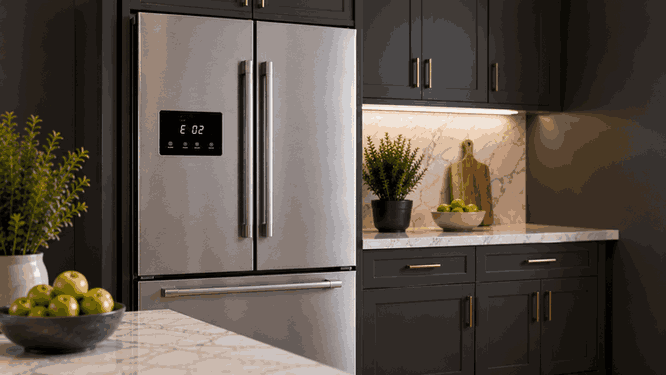
A Thermador freezer high temp alarm can appear when the freezer senses that the internal temperature is higher than expected. The display may show a warning, the alarm may sound, or the freezer may continue running while the temperature does not drop quickly enough.
For San Jose homes, this warning is important because frozen food can begin to soften if the temperature stays elevated for too long. In many cases, the cause is simple, such as a door left open, warm food added at once, blocked airflow, or a poor door seal. In other cases, the alarm may point to a cooling system, sensor, fan, defrost, control, or sealed-system issue.
A Thermador freezer monitors temperature to protect stored food and alert the homeowner when cooling is outside the expected range.
When the door is opened for a long time or a large amount of unfrozen food is placed inside, the freezer temperature rises. The appliance then needs time to pull the temperature back down.
If the temperature does not recover within a reasonable period, the freezer may keep the alarm active. This does not always mean the freezer has failed, but it does mean the condition should be watched carefully.
A freezer loses cold air quickly when the door is open. A large food load can also add heat to the compartment, especially if the food was recently purchased, recently cooked, or not fully chilled before being placed inside.
The freezer may run longer than usual while trying to stabilize. If airflow is blocked or the door does not seal correctly, the temperature may stay too high.
A Thermador freezer high temp alarm door open large food load issue may appear suddenly after normal household use or after grocery storage.
Homeowners may notice:
High temp alarm on the display
Alarm sound after the freezer door was left open
Soft or partially thawed food
Frost buildup around the door area
Freezer runs for a long time
Temperature display stays above the set point
Alarm appears after adding many items
Door does not close fully
Interior airflow feels weak
Warning returns after being cleared
If the alarm appeared after the door was left open or after a large food load, the freezer may simply need time to recover. If the alarm returns when the door is closed, the load is normal, and the freezer has had enough time to cool, the issue may involve the door gasket, evaporator fan, temperature sensor, defrost system, control board, or cooling system.
If food is thawing, the freezer should be treated as an active cooling problem, not just a display warning.
Not every high temperature alarm means the freezer has a major internal failure.
The alarm may be caused by a door left slightly open, a package blocking the door, a damaged or dirty gasket, warm food placed inside, overloaded shelves, blocked vents, or frequent door openings.
A freezer packed too tightly can prevent cold air from moving evenly. Even if the cooling system works, blocked airflow can make the temperature sensor read warmer than expected.
Repair-level causes may include a failing evaporator fan, faulty temperature sensor, defrost failure, control-board issue, compressor-start problem, sealed-system weakness, refrigerant-related cooling loss, or wiring fault.
These problems usually require professional diagnosis because they involve internal parts, electrical testing, or refrigeration system evaluation.
Homeowners can make a few safe checks before requesting service.
Make sure the freezer door is fully closed. Look for packages, bins, or ice buildup preventing the door from sealing. Check whether the gasket is sitting flat against the cabinet and whether visible debris is stopping a tight seal.
If a large amount of food was just added, spread items out so air can move between them. Avoid blocking interior vents. Give the freezer time to recover, especially after long door openings or grocery loading.
Check whether the alarm appeared after a clear event, such as restocking, cleaning, power interruption, or a door left open overnight. This timing can help separate a temporary temperature rise from a freezer-side failure.
Before service, note the displayed temperature, whether the food is still fully frozen, whether the alarm clears and returns, whether the freezer fan seems to run, and whether frost is forming around the door or inside the compartment.
These details help identify whether the problem is related to airflow, sealing, temperature sensing, or cooling performance.
Do not remove interior panels, chip ice with sharp tools, pour hot water into the freezer, test wiring, bypass switches, or force the freezer to keep running through repeated alarm resets.
Do not keep opening the door to “check again” every few minutes. Frequent door openings add warm air and can make the temperature recovery slower.
If food has softened or thawed, follow safe food-storage judgment. The alarm should not be ignored if the freezer is not returning to the correct temperature.
Clearing a Thermador high temp alarm only removes the warning from the display. It does not correct the reason the temperature rose.
If the cause was a door left open or a large warm food load, the freezer may recover normally. But if the alarm returns after the door is sealed and the freezer is not overloaded, the appliance may not be cooling correctly.
Repeated alarms can point to an airflow issue, sensor fault, fan problem, defrost failure, or sealed-system concern.
Bestech Repair checks whether the alarm came from normal use conditions or from a freezer component that is no longer maintaining temperature.
A technician can evaluate door seal condition, gasket contact, airflow, fan operation, frost pattern, temperature sensor response, control-board behavior, defrost activity, compressor operation, and overall cooling performance.
The goal is to confirm whether the freezer is recovering normally or whether the high temperature alarm is warning about a deeper Thermador freezer fault.
The main goal is not only to silence the alarm. The goal is to find out why the freezer temperature rose, whether food storage is still reliable, and whether the issue is likely to return.
A Thermador freezer high temp alarm can affect food storage quickly, especially when the alarm repeats or the freezer does not cool back down. Bestech Repair provides Thermador freezer repair in San Jose for high temperature warnings, door seal problems, airflow issues, fan faults, defrost concerns, sensor problems, control failures, and cooling performance complaints.
For built-in or premium Thermador freezer systems, careful diagnosis is important because temperature problems may involve both user-side conditions and appliance-side components.
A Thermador freezer high temp alarm door open large food load problem may be caused by a door left open, blocked gasket, warm food load, overloaded shelves, blocked vents, repeated door openings, temperature sensor issue, evaporator fan fault, defrost problem, control-board failure, compressor-start issue, or sealed-system cooling weakness.
Homeowners can safely check the door closure, gasket area, food load, airflow space, alarm timing, and displayed temperature. If the alarm returns after the freezer is closed, properly loaded, and given time to recover, professional diagnosis is the safer next step.
Bestech Repair – San Jose, CA
📍 Address: 919 S Winchester Blvd, San Jose, CA 95128
📧 Email: office@bestechrepair.com
📞 Phone: +1-408-906-8668
🕒 Open Hours: Monday – Sunday: 8:00 AM – 8:00 PM.
Read reviews about our repair, installation and maintenance services. Our trained experts are always ready to help. To schedule your next appointment, give us a call or complete our online form.

Leave your contact details for communication with the operator, indicate a convenient date for yourself and our operators will contact you or call us: