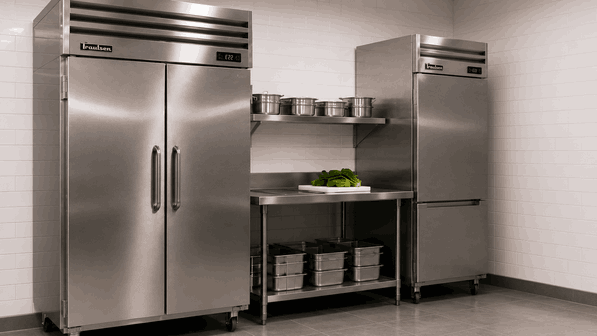
A Traulsen blast chiller defrost failure air temp sensor control problems issue usually means the unit is not reading, cooling, defrosting, or recovering the way the controller expects. Staff may see temperature alerts, defrost-related faults, unstable air readings, slow pull-down, frost buildup, or a blast cycle that does not complete correctly.
For San Jose commercial kitchens, catering operations, prep facilities, and food-service spaces, this problem should be treated as a rapid-cooling reliability issue. A blast chiller depends on strong airflow, accurate air temperature sensing, proper defrost timing, fan operation, compressor response, door sealing, and controller decisions. If one part of that sequence fails, cooling performance can become unpredictable.
A Traulsen blast chiller must remove heat quickly while monitoring air temperature and cabinet conditions. The controller uses sensor feedback to decide whether the unit is cooling properly, when defrost is needed, and whether the cycle is progressing within the expected range.
If the air temperature sensor gives unstable or incorrect feedback, the controller may not know whether the cabinet is actually cooling. If defrost does not complete correctly, frost can block airflow and make the next chilling cycle slower or less reliable.
Staff may notice that food takes longer to chill, the display temperature does not match cabinet behavior, or the unit struggles after several cycles. The blast chiller may alarm during pull-down, after defrost, after heavy loading, or during recovery between batches.
Other clues include frost on interior surfaces, weak airflow, a fan sound change, repeated controller messages, or a cabinet that cools unevenly. If the problem appears after back-to-back use, the unit may be struggling with frost management, airflow restriction, sensor feedback, or refrigeration load.
A defrost failure can prevent the evaporator area from clearing frost properly. When frost blocks airflow, the cabinet may not pull temperature down fast enough, even if the refrigeration system is running.
An air temperature sensor problem is different. The controller may receive a reading that is too high, too low, unstable, or delayed. That can cause incorrect cycle decisions, false alarms, early shutdowns, or extended operation.
Repair-level causes may include failed sensors, unstable wiring, defrost component failure, fan problems, controller faults, compressor stress, refrigerant concerns, sealed-system restrictions, or airflow blockage inside the cabinet.
Staff can safely check whether the door closes fully, gaskets seal evenly, and product loading allows airflow around trays or pans. Avoid packing the cabinet in a way that blocks air movement across the load.
Record the displayed temperature, alarm message, cycle stage, product load size, time of day, and whether the issue appears after defrost, after heavy use, or during the first cycle of the day. If product temperature is not pulling down as required, follow internal food-safety procedures and protect temperature-sensitive inventory when possible.
Do not remove panels, open controller compartments, test wiring, access sensors, scrape internal frost with tools, handle refrigerant lines, or reset breakers repeatedly.
A blast chiller with poor defrost recovery or unreliable air sensing may not deliver consistent rapid cooling. That can affect production timing, holding routines, batch planning, and food-safety procedures.
Clearing the alarm may make the display quieter, but it will not repair a failed sensor, blocked airflow, defrost fault, fan failure, controller issue, wiring problem, compressor strain, or refrigeration-system fault. If the same problem returns, the unit needs proper diagnosis.
Bestech Repair checks the unit as a complete rapid-cooling and defrost-control sequence. A technician can evaluate air temperature sensor response, controller readings, defrost timing, evaporator airflow, fan operation, frost pattern, door sealing, compressor behavior, condenser airflow, wiring condition, and whether the unit recovers properly between cycles.
The goal is to determine whether the Traulsen blast chiller defrost failure air temp sensor control problems start with sensor feedback, defrost performance, airflow restriction, loading conditions, or refrigeration-system operation.
A Traulsen blast chiller with defrost, air sensor, or control problems can disrupt prep schedules, cooling targets, and kitchen workflow. Bestech Repair provides Traulsen commercial refrigeration repair in San Jose for blast chiller defrost failures, unstable air temperature readings, slow pull-down, fan symptoms, sensor faults, controller errors, wiring concerns, and refrigeration performance problems.
Traulsen blast chiller defrost failure, air temperature sensor, and control problems may be caused by heavy product loading, blocked airflow, door-seal issues, frost buildup, failed sensors, unstable wiring, defrost component faults, fan failures, controller problems, compressor stress, refrigerant concerns, or sealed-system restrictions. Staff can safely observe door closure, gasket condition, product spacing, displayed temperature, alarm timing, cycle stage, and whether the unit recovers after defrost. If faults return or chilling performance becomes unreliable, professional diagnosis is the safer next step.
Bestech Repair – San Jose, CA
📍 Address: 919 S Winchester Blvd, San Jose, CA 95128
📧 Email: office@bestechrepair.com
📞 Phone: +1-408-906-8668
🕒 Open Hours: Monday – Sunday: 8:00 AM – 8:00 PM.
Read reviews about our repair, installation and maintenance services. Our trained experts are always ready to help. To schedule your next appointment, give us a call or complete our online form.

Leave your contact details for communication with the operator, indicate a convenient date for yourself and our operators will contact you or call us: