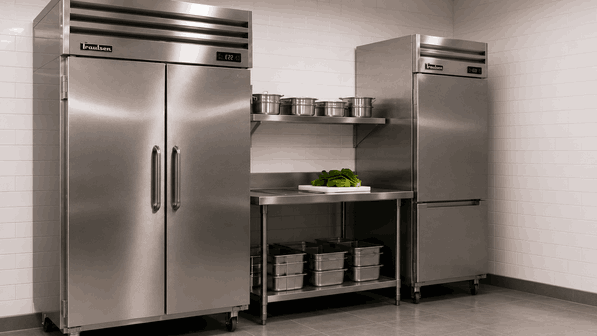
A Traulsen reach-in SN1 SN2 SN3 sensor faults CLO defrost errors issue usually means the cabinet controller is receiving temperature or defrost feedback that does not match normal operation. The reach-in may show sensor-related messages, defrost errors, unstable cabinet temperature, repeated alarms, slow recovery, or a display reading that does not match what staff observe inside the unit.
For San Jose restaurants, cafés, commercial kitchens, and food-service spaces, this type of fault should be handled as a refrigeration-control problem. A Traulsen reach-in depends on accurate sensors, stable airflow, proper defrost timing, fan operation, compressor response, and controller decisions to keep stored product within a reliable temperature range.
A commercial reach-in refrigerator or freezer uses sensor feedback to understand cabinet temperature, coil conditions, and recovery after door openings or defrost. If the controller cannot trust the signal from SN1, SN2, or SN3, it may show an alarm instead of continuing normal operation.
A CLO defrost error may suggest the controller is not seeing the expected defrost or temperature-change behavior. This can happen when a sensor is out of range, a defrost cycle does not complete correctly, airflow is restricted, or the refrigeration system cannot recover as expected.
Staff may notice the fault during morning checks, after a busy service period, after delivery loading, or after the cabinet has been opened frequently. The display may flash a sensor message, cabinet temperature may drift, or the unit may alarm again after being cleared.
Other clues include frost buildup, longer run time, weak airflow, product that does not feel properly chilled, or a temperature reading that changes too quickly or not enough. If defrost errors return, the unit may be having trouble clearing frost, reading coil temperature, or restarting normal cooling afterward.
A sensor fault can cause the controller to misread what is happening inside the cabinet. The unit may cool too long, stop too early, alarm incorrectly, or fail to manage defrost timing properly.
A defrost-related problem can also create sensor faults. Heavy frost, blocked airflow, door gasket leaks, failed fan operation, defrost component issues, wiring faults, controller problems, or sealed-system concerns can all make the sensor readings look abnormal.
The key question is whether the controller is receiving bad information or whether the cabinet is truly failing to cool, defrost, or recover.
Staff can safely check whether doors close fully, gaskets seal evenly, and stored product is not blocking interior airflow. Look for overpacked shelves, items pushed against vents, or frequent door openings during service.
Record the displayed fault, cabinet temperature, time of day, recent stocking, door traffic, and whether frost or moisture is visible inside the cabinet. If product temperature is rising, follow internal food-safety procedures and protect temperature-sensitive inventory when possible.
Do not remove panels, open controller compartments, test wiring, access sensors, clear internal frost with tools, handle refrigerant lines, or reset breakers repeatedly.
Clearing the display may silence the alarm, but it will not repair a failed sensor, wiring issue, defrost fault, fan problem, blocked airflow, compressor stress, or controller failure.
Repeated clearing can hide when the fault appears. Timing matters: a fault during defrost, after door traffic, after stocking, or during normal cooling can point to different causes. If the cabinet does not recover temperature or the same message returns, the reach-in should be checked before inventory is affected.
Bestech Repair checks these faults as a full controller-feedback and refrigeration sequence. A technician can evaluate sensor response, controller readings, defrost timing, evaporator airflow, fan operation, frost pattern, gasket condition, compressor behavior, condenser airflow, wiring condition, and whether the cabinet recovers after defrost.
The goal is to determine whether the Traulsen reach-in SN1 SN2 SN3 sensor faults CLO defrost errors issue starts with sensor feedback, defrost control, airflow restriction, cabinet loading, or refrigeration-system performance.
A Traulsen reach-in with recurring sensor or defrost errors can disrupt prep, storage, service planning, and closing checks. Bestech Repair provides Traulsen commercial refrigeration repair in San Jose for SN1, SN2, and SN3 sensor faults, CLO defrost errors, unstable cabinet temperatures, frost buildup, fan symptoms, compressor concerns, wiring faults, and controller-related problems.
Traulsen reach-in SN1, SN2, SN3, and CLO defrost problems may be caused by failed sensors, unstable probe feedback, wiring issues, controller faults, heavy door traffic, damaged gaskets, blocked airflow, frost buildup, fan failures, defrost malfunction, condenser restriction, compressor stress, or refrigeration-system faults. Staff can safely observe door sealing, product loading, displayed temperature, frost pattern, alarm timing, and whether the cabinet recovers after normal use. If sensor or defrost errors return, professional diagnosis is the safer next step.
Bestech Repair – San Jose, CA
📍 Address: 919 S Winchester Blvd, San Jose, CA 95128
📧 Email: office@bestechrepair.com
📞 Phone: +1-408-906-8668
🕒 Open Hours: Monday – Sunday: 8:00 AM – 8:00 PM.
Read reviews about our repair, installation and maintenance services. Our trained experts are always ready to help. To schedule your next appointment, give us a call or complete our online form.

Leave your contact details for communication with the operator, indicate a convenient date for yourself and our operators will contact you or call us: