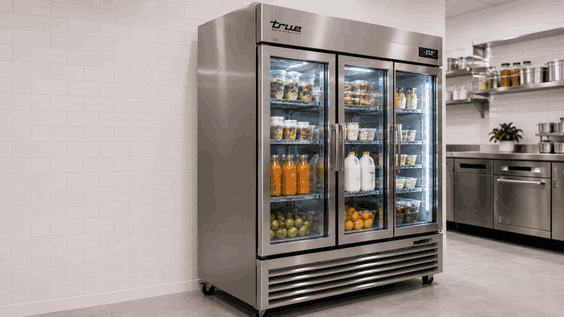
A True commercial refrigeration door open high temp and condenser alarm problems issue can affect food storage, prep timing, and daily kitchen reliability in restaurants, cafés, food-service spaces, shared kitchens, and commercial storage areas. The unit may beep, flash alerts, show rising cabinet temperature, run longer than usual, or warn staff that the door, temperature, or condenser condition needs attention.
For San Jose businesses, these alarms should be reviewed as a temperature-protection pattern. A True commercial refrigerator or freezer depends on door sealing, airflow, condenser heat release, fan response, sensor feedback, and compressor operation. When door-open, high-temp, and condenser-related alarms appear, the cabinet may be struggling to recover and hold safe operating temperature.
A commercial refrigeration system must keep cabinet temperature within a stable range while handling frequent door openings, product loading, and busy kitchen conditions. The controller monitors whether the door is closed, whether temperature is recovering, and whether heat can leave the refrigeration system through the condenser area.
A door open alarm may point to a door left ajar, gasket issue, damaged hinge, or blocked closing path. A high temp alarm means the cabinet temperature has moved above the expected range. A condenser alarm may suggest poor airflow, heavy dust buildup, fan problems, heat exposure, or condenser-side stress.
In a commercial setting, the alarm may appear during rush periods, after deliveries, after frequent door traffic, or after the unit has been loaded with warm product. Staff may notice that the door does not close firmly, the gasket looks loose, or the cabinet takes too long to recover.
Other patterns are more serious. The temperature may keep rising even when the door is closed. The condenser area may feel unusually hot. The unit may run constantly, fans may sound different, or the same alarm may return after being cleared. Those signs can point beyond normal door use.
Some alarm events are caused by visible operating conditions. Doors may be left open during stocking. Shelves may be overloaded. Product may block airflow. A gasket may be dirty or not sealing evenly. Warm kitchen conditions can also slow temperature recovery.
Condenser-side problems are different. A restricted condenser, weak condenser fan, blocked ventilation, compressor stress, dirty coil area, sensor fault, wiring issue, controller problem, or sealed-system concern can keep the unit from releasing heat properly. When condenser problems are present, the cabinet may not cool correctly even after the door is closed.
Staff can safely check whether the door closes completely, whether products are blocking the door, and whether the gasket makes even contact. Look for obvious gaps, loose items near hinges, or shelving that prevents the door from sealing.
Check whether interior airflow is blocked by overpacked shelves. Make sure the area around the unit has visible clearance and is not surrounded by heat-producing equipment. Record the alarm message, cabinet temperature, time of day, and whether the problem followed stocking, cleaning, delivery, or heavy service use.
Do not remove panels, access the condenser compartment, test wiring, reset breakers repeatedly, handle refrigerant lines, clear internal components with tools, or keep relying on the unit if temperature continues rising.
Silencing a door-open, high-temp, or condenser alarm may stop the noise, but it does not correct poor door sealing, blocked airflow, condenser restriction, fan failure, compressor strain, sensor problems, or controller faults.
If the cabinet temperature does not recover, staff should follow internal food-safety procedures and protect temperature-sensitive inventory when possible. Repeated alarm clearing can hide the timing of the failure and delay service decisions.
Bestech Repair checks the alarm as a complete cooling and heat-rejection sequence. A technician can evaluate door closure, gasket condition, cabinet temperature recovery, airflow pattern, condenser performance, fan operation, compressor behavior, sensor feedback, wiring condition, and controller response.
The goal is to determine whether the True commercial refrigeration door open high temp and condenser alarm problems come from staff-visible door or loading conditions, condenser airflow trouble, a refrigeration component fault, or an electronic control issue.
A True commercial refrigerator or freezer with recurring door, high-temp, or condenser alarms can disrupt prep, product storage, and service planning. Bestech Repair provides True commercial refrigeration repair in San Jose for door-open alerts, high-temperature alarms, condenser warnings, slow recovery, fan issues, compressor concerns, sensor faults, wiring problems, and controller-related failures.
True commercial refrigeration door open, high temp, and condenser alarm problems may be caused by frequent door traffic, blocked door closure, damaged gaskets, overloaded shelves, poor cabinet airflow, warm product loading, blocked ventilation, condenser restriction, fan failure, compressor stress, sensor faults, wiring issues, or controller failure. Staff can safely observe door sealing, product placement, cabinet temperature, alarm timing, and visible airflow clearance. If alarms return or temperature recovery remains slow, professional diagnosis is the safer next step.
Bestech Repair – San Jose, CA
📍 Address: 919 S Winchester Blvd, San Jose, CA 95128
📧 Email: office@bestechrepair.com
📞 Phone: +1-408-906-8668
🕒 Open Hours: Monday – Sunday: 8:00 AM – 8:00 PM.
Read reviews about our repair, installation and maintenance services. Our trained experts are always ready to help. To schedule your next appointment, give us a call or complete our online form.

Leave your contact details for communication with the operator, indicate a convenient date for yourself and our operators will contact you or call us: