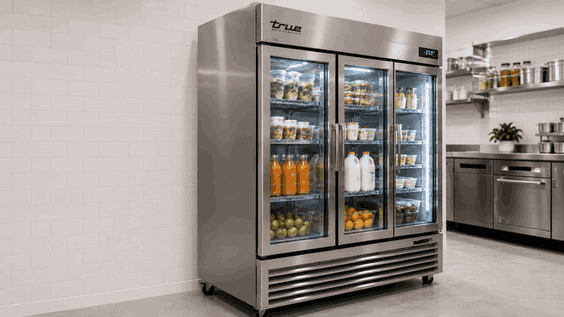
A True commercial refrigeration line voltage communication and refrigerant leakage alarms issue can affect food storage, service flow, and equipment reliability in restaurants, cafés, commercial kitchens, grocery prep areas, and shared food-service spaces. The unit may beep, flash an alarm, lose temperature stability, show communication warnings, or indicate a possible refrigeration-system concern.
For San Jose businesses, this type of alarm should be treated as an operating-risk signal, not just a display message. A True commercial refrigerator or freezer depends on stable power, controller feedback, temperature sensing, fan response, compressor operation, and sealed refrigeration performance. When line voltage, communication, and refrigerant-related alarms appear, the unit may be warning that it cannot reliably protect stored products.
A True commercial refrigeration unit has to confirm that power is stable, the controller can communicate with key components, and the cabinet temperature is moving in the expected direction. It also depends on sealed-system pressure and refrigerant condition to remove heat from the cabinet.
A line voltage alarm may point toward unstable power, supply interruption, voltage irregularity, or control input trouble. A communication alarm may suggest that the controller is not receiving expected feedback from part of the system. A refrigerant leakage alarm or leakage-related warning should be taken seriously because refrigerant loss can reduce cooling performance and may lead to repeated temperature problems.
In a commercial setting, the first sign may be a display warning during prep, closing checks, or morning startup. Staff may notice that the unit runs longer, cabinet temperature rises, product feels warmer, fans sound different, or the alarm returns after being cleared.
Some alarms appear after a power event, outlet issue, cleaning, heavy door traffic, blocked ventilation, or equipment being moved. Others appear gradually as the unit struggles to maintain temperature under normal load. If alarms return together, the issue may involve more than one system condition.
Staff can safely observe visible conditions around the equipment. A blocked condenser area, poor airflow around the cabinet, overloaded shelves, doors left open, damaged gaskets, or a power strip being used incorrectly can all affect commercial refrigeration performance.
Repair-level causes are different. These may include controller communication faults, wiring problems, voltage supply issues, compressor start problems, fan failures, sensor faults, refrigerant leakage, sealed-system restriction, control-board failure, or component damage. Staff should not open electrical compartments, test voltage, handle refrigerant, or attempt sealed-system work.
Staff can safely confirm whether the cabinet doors close fully, whether gaskets are sealing, and whether product is blocking interior airflow. Check whether the unit has enough visible clearance for ventilation and whether nearby heat sources are affecting the cabinet.
Record the alarm message, time of day, cabinet temperature, and whether the alarm appeared after cleaning, door traffic, power interruption, or product loading. If product temperature is rising, follow internal food-safety procedures and protect temperature-sensitive inventory when possible.
Do not remove panels, test wiring, reset breakers repeatedly, access the compressor area, clear internal electrical parts, handle refrigerant lines, or keep relying on the unit if temperatures are not stable.
Clearing the alarm may silence the display, but it will not correct unstable voltage, communication failure, fan problems, refrigerant loss, compressor stress, or controller faults. In a commercial kitchen, repeated clearing can make the issue look less urgent while stored product continues to warm.
If the alarm returns after normal use, or if temperature recovery becomes slow, the unit should be evaluated before the problem affects service, inventory, or compliance routines.
Bestech Repair checks the alarm pattern as a complete commercial refrigeration sequence. A technician can evaluate power response, controller communication, temperature history, sensor feedback, fan operation, compressor behavior, condenser airflow, wiring condition, refrigerant-system symptoms, and whether alarms are tied to operating load or power events.
The goal is to separate visible use conditions from True commercial refrigeration electrical, communication, controller, refrigerant, or sealed-system faults. This helps reduce unnecessary downtime and supports safer equipment decisions for food-service operations.
A True commercial refrigeration alarm can interrupt prep, storage, and service planning if the cabinet temperature becomes unreliable. Bestech Repair provides True commercial refrigeration repair in San Jose for line voltage alarms, communication faults, refrigerant leakage warnings, temperature instability, fan problems, compressor concerns, sensor issues, wiring faults, and controller-related failures.
True commercial refrigeration line voltage, communication, and refrigerant leakage alarms may be caused by unstable power, poor ventilation, blocked airflow, heavy door traffic, damaged gaskets, controller communication faults, sensor problems, fan failures, compressor issues, wiring faults, refrigerant loss, sealed-system restrictions, or control-board failure. Staff can safely observe temperature behavior, door sealing, visible airflow clearance, alarm timing, and whether the unit recovers after normal use. If alarms return or cabinet temperature becomes unstable, professional diagnosis is the safer next step.
Bestech Repair – San Jose, CA
📍 Address: 919 S Winchester Blvd, San Jose, CA 95128
📧 Email: office@bestechrepair.com
📞 Phone: +1-408-906-8668
🕒 Open Hours: Monday – Sunday: 8:00 AM – 8:00 PM.
Read reviews about our repair, installation and maintenance services. Our trained experts are always ready to help. To schedule your next appointment, give us a call or complete our online form.

Leave your contact details for communication with the operator, indicate a convenient date for yourself and our operators will contact you or call us: