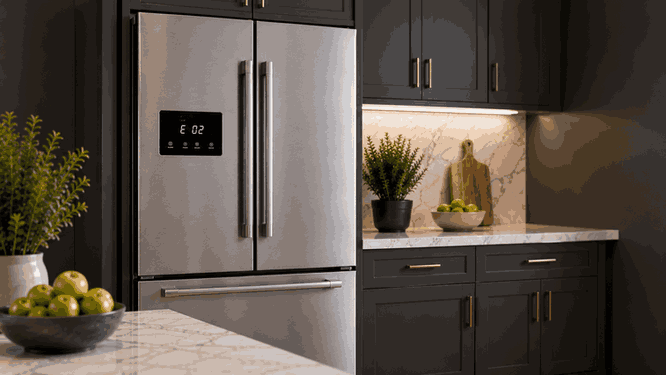
A Viking refrigerator high temp warning cooling problem usually means the refrigerator or freezer section is warmer than the control expects. The display may show a high temperature alert, the cabinet may feel too warm, food may soften, ice may melt, or the appliance may run longer than normal without reaching the selected temperature.
For San Jose homes, this type of Viking refrigerator issue should be handled carefully because it can involve both food safety and appliance performance. A high temp warning may be connected to poor airflow, door sealing problems, heavy loading, condenser restriction, evaporator fan trouble, thermistor feedback, defrost faults, compressor performance, sealed-system issues, or electronic control response.
A Viking refrigerator monitors cabinet temperature so it can keep fresh food and frozen items within a safe cooling range.
The control depends on sensor feedback to understand whether the refrigerator compartment, freezer compartment, or dual-zone section is cooling correctly. If the temperature stays too high, rises too quickly, or does not recover after a door opening, the appliance may store a warning.
A high temp alert may remain active when the cabinet has not cooled back down, the sensor is still reading an unsafe temperature, or the control is receiving unstable cooling feedback. In that case, clearing the alert does not solve the cooling problem.
A Viking refrigerator high temp warning cooling problem may appear after a power interruption, heavy grocery loading, door seal issue, long door opening, or an internal cooling failure.
You may notice:
High Temp or temperature warning on the display
Refrigerator section feels warmer than normal
Freezer items begin to soften
Ice maker slows down or ice melts together
Compressor or fans seem to run constantly
Temperature improves briefly, then rises again
Warning returns after a reset
One compartment cools better than the other
If both refrigerator and freezer temperatures rise, the problem may involve the main cooling system, condenser airflow, compressor operation, control response, or sealed-system performance. If only one section is warm, the issue may involve airflow, damper operation, fan activity, sensor feedback, door sealing, or defrost-related blockage.
Not every high temp warning starts with a failed part. Some conditions can be visible from outside the appliance, while others require professional diagnosis.
A refrigerator door may not be sealing fully because of a blocked shelf, bin, food package, or uneven closure. Warm groceries placed inside the unit can also raise cabinet temperature for a period of time. Dirty or blocked exterior ventilation areas may make heat removal harder, depending on the installation.
Repair-level causes may include a failed evaporator fan, condenser fan issue, thermistor fault, damper problem, defrost system failure, control-board fault, compressor start problem, refrigerant restriction, sealed-system leak, or communication issue between the temperature sensors and control.
A Viking refrigerator can still have lights, display power, and fan noise while the cooling system is not performing correctly. That can make the problem easy to underestimate.
If the temperature remains too high, food quality can decline and frozen items can thaw. Repeated resets may also erase useful timing clues without fixing the cause. The most important detail is not only that the warning appeared, but when it appeared, which compartment was affected, and whether the temperature recovered or kept rising.
Homeowners can check a few visible items without opening panels or touching internal parts.
Write down the exact warning shown on the display. Note whether the issue affects the refrigerator section, freezer section, or both. Check whether the doors close fully and whether gaskets look folded, loose, dirty, or blocked by food containers.
Look for recently added warm food, heavy loading, or long door openings. Make sure interior vents are not blocked by packages. If food has been exposed to unsafe temperatures for too long, move items to another working refrigerator or freezer when possible.
Do not remove panels, test wiring, bypass door switches, force fan covers, access compressor parts, handle refrigerant components, or repeatedly reset the refrigerator to keep it running. Cooling and sealed-system faults require proper diagnostic equipment and safe service procedures.
A reset may clear a High Temp alert temporarily, but it will not repair a fan failure, blocked airflow path, failed thermistor, defrost fault, compressor problem, control-board issue, or sealed-system defect.
If the warning returns after one basic restart, or if the refrigerator does not begin cooling normally, stop repeated attempts. Preserving the failure pattern helps identify whether the problem is related to startup, airflow, sensor reading, defrost behavior, compressor operation, or temperature recovery.
Bestech Repair checks whether the warning is caused by visible cabinet conditions, airflow restriction, temperature sensor feedback, or a deeper cooling-system fault.
A technician can evaluate refrigerator and freezer temperature behavior, door gasket condition, airflow patterns, evaporator fan response, condenser fan operation, thermistor feedback, defrost activity, compressor startup, control-board communication, and cooling recovery after the warning appears.
The goal is to separate a simple door, loading, or airflow issue from a Viking refrigerator cooling failure involving sensors, fans, defrost components, controls, compressor operation, or sealed-system performance.
A refrigerator with a High Temp warning can interrupt daily food storage even when the appliance still sounds like it is running. Bestech Repair provides Viking refrigerator repair in San Jose for high temperature alerts, cooling loss, freezer warming, fresh-food temperature problems, fan issues, defrost faults, sensor errors, and control-related cooling concerns.
A Viking refrigerator high temp warning cooling problem may be caused by blocked airflow, door sealing trouble, heavy loading, fan failure, thermistor fault, defrost issue, condenser restriction, compressor trouble, control-board failure, or sealed-system performance loss. Homeowners can safely note the warning, check door closure, review loading conditions, keep vents clear, and monitor which compartment is warming. If the temperature does not recover or the alert returns, professional diagnosis is the safer next step.
Bestech Repair – San Jose, CA
📍 Address: 919 S Winchester Blvd, San Jose, CA 95128
📧 Email: office@bestechrepair.com
📞 Phone: +1-408-906-8668
🕒 Open Hours: Monday – Sunday: 8:00 AM – 8:00 PM.
Read reviews about our repair, installation and maintenance services. Our trained experts are always ready to help. To schedule your next appointment, give us a call or complete our online form.

Leave your contact details for communication with the operator, indicate a convenient date for yourself and our operators will contact you or call us: