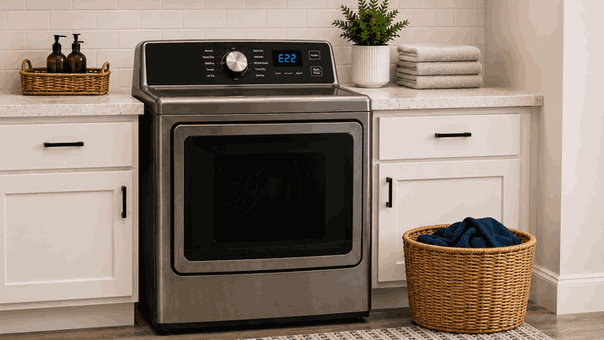
A Whirlpool dryer F6E1 F6E3 F1E1 control board and F3E2 moisture sensor faults issue usually means the dryer is having trouble with electronic control communication, cycle decisions, or moisture-sensing feedback. The dryer may power on but stop early, fail to start, shut down during Auto Dry, show repeated fault codes, or leave clothes damp even when the cycle appears complete.
For San Jose homes, this fault group should be reviewed as a control-and-sensing problem. A dryer has to confirm user input, drum movement, heat control, airflow conditions, sensor feedback, and board communication before it can run a reliable drying cycle.
A Whirlpool dryer does more than heat and tumble. During sensor-based cycles, it checks moisture levels through the moisture sensor bars and uses that information to decide how long the load should continue drying.
The F3E2 moisture sensor side points toward a sensing problem that can confuse Auto Dry behavior. The F6E1, F6E3, and F1E1 side may point toward control-board, communication, or electronic decision faults. When these issues appear together, the dryer may not know whether clothes are wet, whether the cycle should continue, or whether the control system is responding correctly.
The dryer may start normally and then stop before clothes are dry. It may run on Timed Dry but fail during Auto Dry. Some homeowners notice that the display works, but cycle time changes oddly, the dryer shuts off too soon, or the same fault returns after clearing.
Other clues include buttons that respond inconsistently, a display that freezes, a cycle that will not start, or a dryer that heats but does not make correct drying decisions. If the fault appears only on sensor cycles, the moisture sensor path may be more involved. If multiple cycles fail, the control system may need closer evaluation.
A moisture sensor issue can make the dryer think clothes are dry when they are still damp, or it may prevent the dryer from reading load moisture correctly. Lint film, residue from dryer sheets, poor contact with small loads, or sensor wiring problems may affect the feedback.
Control-board faults are broader. Possible repair-level causes include failed electronic control, communication fault, keypad/interface issue, wiring problem, relay failure, sensor circuit fault, or internal board failure. If the dryer also has start failures, display problems, or repeated control errors, the issue may not be limited to the moisture sensor.
Homeowners can safely note which cycles fail. Try to observe whether the problem happens on Auto Dry, Timed Dry, or every setting. Check whether clothes are touching the sensor area during sensor cycles, especially with very small loads.
Also check visible lint screen condition and make sure the dryer is not overloaded. Poor airflow can affect drying results and may make control decisions seem incorrect.
Do not remove panels, test wiring, access internal sensors, bypass door switches, inspect the control board, or continue using the dryer if it smells hot, overheats, sparks, or shows unstable electrical behavior.
If there is a burning smell or overheating, stop using the dryer and request service. A dryer that runs with control faults, airflow problems, or heat regulation issues should not be forced through repeated cycles.
Even if the fault seems electronic, drying performance and heat safety are connected. A control problem can affect cycle timing, while poor airflow or heat stress can make electronic failures more noticeable.
Running the same load again may dry the clothes eventually, but it does not fix sensor feedback, control-board communication, wiring, airflow, or heat-control problems. It can also make it harder to tell whether the dryer is stopping because it thinks the load is dry or because the control system is failing.
The most useful details are when the dryer stops, which cycle was selected, whether heat was present, whether clothes were still damp, and whether the display or buttons behaved normally.
Bestech Repair checks the dryer as a connected sensing, airflow, and control sequence. A technician can evaluate moisture sensor feedback, control-board response, keypad communication, cycle selection behavior, door-switch feedback, wiring condition, heating control, airflow influence, and whether the fault appears only under specific cycle conditions.
The goal is to separate a moisture-sensing issue from a broader Whirlpool dryer control-board or communication failure. That distinction matters because damp clothes, early shutdowns, and repeated fault codes can come from different systems.
A Whirlpool dryer F6E1 F6E3 F1E1 control board and F3E2 moisture sensor faults issue can disrupt laundry routines and make drying results unreliable. Bestech Repair provides Whirlpool dryer repair in San Jose for control-board faults, moisture sensor errors, damp-load problems, early shutdowns, keypad issues, wiring concerns, airflow-related symptoms, and dryer heat-control failures.
Whirlpool dryer F6E1, F6E3, F1E1, and F3E2 faults may be caused by moisture sensor feedback problems, lint or residue on sensor areas, small-load contact issues, wiring faults, keypad communication trouble, electronic control failure, relay problems, airflow restrictions, or heat-control issues. Safe checks include noting which cycles fail, whether Auto Dry behaves differently from Timed Dry, whether clothes stay damp, and whether the dryer shows overheating or burning smells. If the faults return or drying becomes unreliable, professional diagnosis is the safer next step.
Bestech Repair – San Jose, CA
📍 Address: 919 S Winchester Blvd, San Jose, CA 95128
📧 Email: office@bestechrepair.com
📞 Phone: +1-408-906-8668
🕒 Open Hours: Monday – Sunday: 8:00 AM – 8:00 PM.
Read reviews about our repair, installation and maintenance services. Our trained experts are always ready to help. To schedule your next appointment, give us a call or complete our online form.

Leave your contact details for communication with the operator, indicate a convenient date for yourself and our operators will contact you or call us: