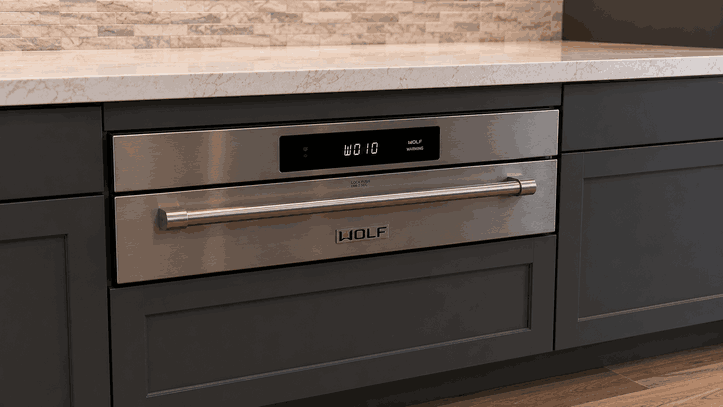
A Wolf warming drawer preheat problem or repeated fault message usually means the drawer is not reaching, reading, or holding the selected warming temperature correctly. The drawer may take too long to preheat, stop before it stabilizes, show the same warning again, or feel cooler than the setting suggests.
For San Jose homeowners, this can disrupt meal timing, especially when the warming drawer is used to hold dishes, keep sides ready, or support larger cooking plans. The issue may involve temperature sensing, heating response, drawer closure, control timing, ventilation, or an electronic control fault.
A Wolf warming drawer is designed to maintain gentle, consistent heat. Unlike an oven, it is not trying to cook food aggressively. It must preheat gradually, monitor internal temperature, and hold a controlled range without overheating or underheating.
When preheat fails or a fault returns, the control system may not be receiving the expected temperature feedback. The drawer may be heating too slowly, losing heat, or detecting a control condition that does not match the selected setting.
A one-time warning may follow a power interruption, incomplete startup, or unusual use condition. Repeated fault messages are different. They suggest the drawer is seeing the same problem again during preheat, heat holding, or control monitoring.
If the warning appears shortly after startup, the issue may involve temperature sensor response, control input, or a heating circuit. If it appears after the drawer warms for a while, the problem may involve heat stability, sensor drift, ventilation, or a control-board response.
The timing of the fault is important because warming drawer problems are often about temperature control, not just power.
Wolf warming drawer preheat and fault-message problems may show signs such as:
Drawer takes too long to preheat
Temperature feels lower than selected
Fault message returns after reset
Drawer warms briefly, then stops
Control panel responds but heat is weak
Food cools instead of staying warm
Drawer feels uneven from side to side
Warning appears during holding mode
These clues help separate a use-condition issue from a sensor, heater, relay, or control fault.
Some warming drawer problems begin with visible conditions. The drawer may not be fully closed. Dishes may block airflow inside the drawer. The selected setting may be too low for the amount of food being held. Opening the drawer often can also slow recovery.
Moisture, crumbs, or residue near the control area may affect input on some models. A recent power interruption can also trigger a temporary fault or reset condition.
Repair-level causes are different. A faulty temperature sensor, weak heating element, relay failure, damaged control board, wiring issue, thermal protection fault, or internal connection problem can cause repeated preheat failures or recurring messages.
If the same fault returns across normal use, the drawer likely needs diagnosis.
Start with safe visible checks. Make sure the drawer closes fully and nothing is blocking the front, rails, or interior space.
Check the selected mode and temperature setting. Allow a normal preheat period before judging performance.
Avoid overloading the drawer or covering areas that allow heat to circulate. Leave space around dishes so warm air can move.
Wipe visible crumbs, grease, or moisture from the drawer edge and control area with a soft, dry cloth.
If the breaker has tripped, reset it only once. If it trips again, stop using the appliance and request service.
Do not remove panels, pull the drawer from the cabinet, test wiring, inspect heating parts, replace sensors, or bypass controls.
Resetting the drawer may clear the fault message temporarily, but it will not repair a weak heating element, failed sensor, relay issue, or control-board problem.
Repeated resets can also hide the most useful pattern. Whether the message appears during startup, preheat, holding, or after the drawer has warmed helps identify the failing system.
If the warming drawer keeps showing the same warning, continued use may make temperature control less reliable.
Bestech Repair approaches Wolf warming drawer preheat problems and repeated fault messages by checking how the drawer responds from startup through heat stabilization. A technician can evaluate control input, preheat timing, temperature sensor feedback, heating element response, relay behavior, drawer closure, ventilation, wiring communication, and control-board operation.
The goal is to separate a simple loading or setting issue from a true warming drawer control or heating fault.
Wolf warming drawers are often part of premium kitchens where timing and temperature consistency matter. In San Jose homes, repeated preheat faults can affect meal prep, entertaining, and multi-dish cooking.
Bestech Repair provides Wolf warming drawer repair in San Jose, including preheat problems, repeated fault messages, weak heating, control issues, sensor faults, drawer closure concerns, and temperature instability.
A Wolf warming drawer preheat problem or repeated fault message may be caused by incomplete drawer closure, low settings, overloading, blocked heat circulation, frequent opening, sensor faults, weak heating elements, relay problems, wiring issues, or control-board failure. Homeowners can safely check drawer closure, settings, loading, visible residue, and breaker status once. If the same fault returns, professional Wolf warming drawer diagnosis is the safer next step.
Bestech Repair – San Jose, CA
📍 Address: 919 S Winchester Blvd, San Jose, CA 95128
📧 Email: office@bestechrepair.com
📞 Phone: +1-408-906-8668
🕒 Open Hours: Monday – Sunday: 8:00 AM – 8:00 PM.
Read reviews about our repair, installation and maintenance services. Our trained experts are always ready to help. To schedule your next appointment, give us a call or complete our online form.

Leave your contact details for communication with the operator, indicate a convenient date for yourself and our operators will contact you or call us: