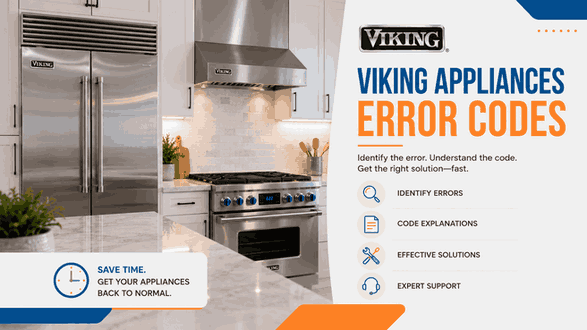
A Viking error code usually makes the most sense when it is read together with the way the appliance is actually working. The display may show only a short warning, but the real issue often appears through daily use. An oven may stop heating correctly, fail to finish a cooking function, or stop responding the way it should. A dishwasher may interrupt the cycle because too much water has entered the unit or because leak protection has been triggered. A refrigeration unit may show that one compartment is becoming too warm, too cold, or losing stable temperature control.
For homeowners in San Jose and across the Bay Area, these alerts are best understood as system warnings tied to appliance performance, not final diagnoses. In many cases, the code does not identify one exact failed part by itself. Instead, it points to the function that is losing stability. That may involve temperature sensing, probe response, latch operation, keypad communication, model configuration, water-protection systems, or refrigeration zone control.
Many Viking appliances begin showing trouble before they stop completely. The unit may still power on and perform part of its normal job, but reliability is already changing. That is often when repeated alerts begin appearing.
A one-time code can sometimes follow a short interruption. A warning that keeps returning usually means more. In practical home use, repeated Viking warnings often fall into a few larger patterns: sensor trouble, control communication faults, latch-related problems, water-protection issues, and temperature-control instability. Once the same message keeps coming back, the main question becomes whether the appliance can still be trusted in normal kitchen use.
For Viking ovens, the main family in this text is:
MODEL ERROR / RTD ERROR / PROBE ERROR / LATCH ERROR / KEYBOARD ERROR
These alerts usually point to an incorrect control configuration, an open or shorted oven temperature sensor, a meat-probe circuit problem, a latch mechanism fault, or a missing connection between the keypad and control. In daily use, that may look like an oven that does not heat correctly, will not complete certain functions, or stops responding normally to commands.
What makes these warnings important is the loss of predictable cooking performance. The oven may still turn on, but once heat sensing, latch behavior, or control communication becomes unstable, normal use becomes harder to trust.
For Viking Chill Refrigeration, the main code group here is:
HIGH TEMP / oPn / Shr / Upper unit too warm / Upper unit too cold / Lower unit too warm / Lower unit too cold / Error Code... / Lower too warm / Lower too cold / Upper too warm / Upper too cold
These alerts usually point to a refrigeration compartment that is moving outside its expected temperature range, a sensor condition that may be open or shorted, or an upper/lower zone that is no longer holding temperature consistently. In daily use, that may look like food or beverages not staying properly chilled, one section feeling noticeably warmer than the other, or a dual-zone unit repeatedly showing upper or lower compartment warnings.
The important issue is temperature dependability. A Viking refrigeration unit may still run, but if HIGH TEMP, upper too warm, lower too warm, upper too cold, or lower too cold messages keep returning, the appliance is already showing that cooling performance is becoming unstable. These warnings should be read together with real symptoms, such as changing compartment temperature, unusual cycling, or inconsistent cooling between sections.
For Viking dishwashers, the main code group here is:
E:01
This alert usually points to too much water entering the machine or to a leak condition being detected. In real use, that may show up as interrupted operation, water where it should not be, or a dishwasher that stops running to protect the unit.
Even though this is a shorter code list, the warning matters because it affects one of the most important dishwasher functions: safe water handling. Once overfill or leak protection is triggered, the appliance may no longer continue the cycle normally.
The best first step is to compare the code with what the appliance is actually doing.
If the oven is heating poorly, rejecting commands, or failing to complete functions, if the dishwasher is stopping because of excess water or leak-related conditions, or if a refrigeration unit is showing upper/lower temperature warnings, the appliance is already showing the real context behind the alert.
A repeated Viking alert usually means more than a brief interruption. It often shows that one of the appliance’s key systems is losing stability.
Viking error codes are most useful when they are treated as early signs of changing appliance dependability. They may not identify the exact failed component by themselves, but they often show which function is under stress and whether the appliance can still be trusted in everyday use.
For customers in San Jose and throughout the Bay Area, professional in-home service can help connect the recurring code to the symptom the appliance is actually showing, identify why the warning keeps returning, and determine the next repair step.
📍 Address: 919 S Winchester Blvd, San Jose, CA 95128
📧 Email: office@bestechrepair.com
☎️ Phone: (408) 906-8668
This Viking appliance error code table organizes each Viking fault code by appliance type, listed meaning, initial check, technician service note, and related help when available. It includes Viking oven, dishwasher, and refrigeration error codes, so each display message can be matched with the correct table row and reviewed with Viking’s official Product Documentation and Support FAQs resources.
| Error Code | Appliance | Meaning | Safe first steps | Technician required | Related help |
|---|---|---|---|---|---|
| HIGH TEMP | Refrigerator | 5 Series built-in refrigerator/freezer high-temperature alarm; the refrigerator or freezer temperature has been too high for two hours. | Press ALARM OFF to mute the audible alarm. Verify that doors are fully closed, controls are set correctly, and recent loading or power interruption is not preventing recovery. | Yes — if the temperature does not recover or the alarm returns after safe checks. | |
| oPn | Refrigerator | 5 Series built-in temperature sensor alarm; the electronic control senses a temperature-sensor problem and the display shows oPn. | Press ALARM OFF to mute the alarm. Do not remove panels or test wiring. Confirm the display returns to a normal temperature reading. | Yes — if the display does not return to temperature, Viking says to contact an authorized technician immediately. | |
| Lower too warm | Wine Cellar | Wine Cellar / integrated wine cabinet lower-compartment temperature warning; the lower compartment is too warm. | Press ALARM to view the fault message. Check door closure, recent loading, temperature setting, and condenser cleanliness using only normal owner-level steps. | Yes — if the condition does not resolve or appears with a malfunction code / service message. | |
| Lower too cold | Wine Cellar | Wine Cellar / integrated wine cabinet lower-compartment temperature warning; the lower compartment is too cold. | Press ALARM to view the fault message. Wait up to 12 hours as directed by the manual. | Yes — if the malfunction persists after 12 hours, call Customer Service. | |
| LATCH ERROR | Wall Ovens | Incorrect model number has been installed / configured in the control. | Power-cycle once at the breaker. If the message remains, do not continue troubleshooting beyond normal reset. | Yes — call Viking dealer or authorized service if the message remains. | Viking Wall Oven Model Error Control Configuration Service Issue |
| KEYBOARD ERROR | Wall Ovens | Oven RTD temperature sensor is open or shorted. | Power-cycle once at the breaker and retest. Do not disassemble the unit. | Yes — authorized service is required if the message returns. | Viking Wall Oven RTD and Probe Error Temperature Sensor Problems |
| E:01 | Dishwasher | Machine has taken in too much water or a leakage condition is detected. | Turn the dishwasher off. If leakage is suspected, shut off the water supply and do not continue operation. After conditions normalize, see whether the message clears. | Yes — if E:01 does not disappear, the manual indicates a permanent fault and authorized service should be contacted. |
Read reviews about our repair, installation and maintenance services. Our trained experts are always ready to help. To schedule your next appointment, give us a call or complete our online form.

Leave your contact details for communication with the operator, indicate a convenient date for yourself and our operators will contact you or call us: