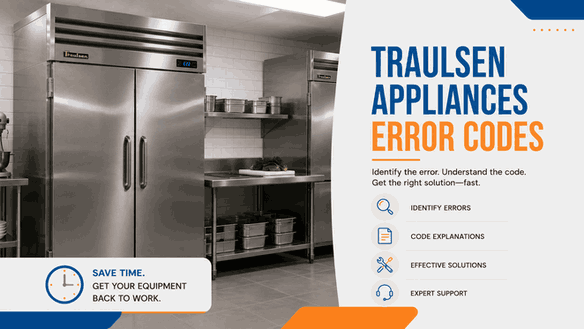
A Traulsen error code usually becomes more useful when it is connected to the way the equipment is actually performing. The display may show only a short warning, but the real problem often appears in day-to-day operation. A reach-in or pass-thru may stop holding cabinet temperature correctly. An equipment stand or undercounter may keep running while line-ready storage becomes less stable. A blast chiller may interrupt the chill cycle, reject probe input, or fail to complete the process the kitchen depends on.
For customers in San Jose and across the Bay Area, these alerts are best understood as commercial refrigeration warnings tied to real operating performance, not final diagnoses. In many cases, the code does not identify one exact failed part by itself. Instead, it points to the system that is losing stability. That may involve cabinet temperature control, power-loss response, condenser condition, sensor feedback, defrost function, compressor runtime, or chill-cycle monitoring.
Many refrigeration problems begin before the unit fully stops. Equipment may still be running, but holding conditions, recovery speed, or chill-cycle consistency are already changing. That is often when repeated alerts begin appearing.
A one-time warning can sometimes follow a short interruption. A code that keeps returning usually means more. In practical commercial use, repeated Traulsen alerts often fall into a few larger patterns: cabinet-temperature instability, sensor failures, condenser or airflow warnings, power-loss events, defrost trouble, and chill-cycle interruptions. Once the same message keeps coming back, the main question becomes whether the unit can still support normal storage, prep, or service flow.
For Traulsen reach-in and pass-thru units, one of the most important groups is:
cHI / cLO
These alerts usually point to cabinet air temperature moving too high or too low for normal operation. In commercial use, that may show up as unstable food storage, longer recovery times, or refrigeration performance that needs quick attention.
Power-loss alarm: Electrical Loss
Door-open alarm: Door Open
Condenser-clean alarm: Clean Filter
Sensor-failure alarms: SN1 / SN2 / SN3
Compressor runtime alarm: rUn Err
Defrost-failure alarm: DEF Err
For Traulsen equipment stands, the main family is:
HI CAb / Lo Cab
These warnings usually point to cabinet air temperature rising too high or dropping too low.
Power-loss alarm: ELE LOS
Condenser-clean alarm: Clean Filter
Cabinet sensor failure alarm: CAB SEN
Coil sensor failure alarm: COL SEN
Discharge sensor failure alarm: DIS SEN
For Traulsen undercounters, the central family is:
HI CAb / Lo Cab
These alerts usually point to cabinet temperature moving outside the normal operating range. Other undercounter groups may include the same related warnings for power loss, condenser cleaning, and sensor faults.
What links these refrigeration warnings together is holding stability. The unit may still have power, but once cabinet temperature drifts or sensor alarms repeat, normal product protection is already being affected.
For Traulsen blast chillers, the main group here is:
CURRENT PROBE IS BAD / FAILED PROBE (#1) / CHILL TIME EXCEEDED / NO PRODUCT PROBES / OVER TEMPERATURE / AIR TEMP SENSOR NOT READING
These alerts usually point to food-probe failure, missing probes, excessive chill time, cabinet air-sensor trouble, or unsafe temperature rise. In commercial use, that may interrupt kitchen workflow and prevent the unit from completing a normal chill process.
Defrost-related fault: DEFROST FAILURE
Automatic hold-mode message: PRODUCT DETECTED! STARTING HOLD MODE
What makes these alerts important is the direct effect on production timing and safe temperature control. A blast chiller problem is not only about the code on the screen. It affects whether the unit can complete the cooling task the kitchen is relying on.
The best first step is to compare the code with what the equipment is actually doing.
If cabinet temperature is rising, if recovery is taking too long, if condenser or sensor warnings keep repeating, or if the blast chiller is failing to complete normal chill cycles, the equipment is already showing the real context behind the alert.
A repeated Traulsen warning usually means more than a brief interruption. It often shows that one of the unit’s key systems is losing stability and that normal commercial use is already being affected.
Traulsen error codes are most useful when they are treated as early signs of changing equipment dependability. They may not identify the exact failed component by themselves, but they often show which function is under stress and whether the unit can still be trusted in real operation.
For customers in San Jose and throughout the Bay Area, professional commercial service can help connect the recurring code to the actual symptom, identify why the warning keeps returning, and determine the next repair step.
📍 Address: 919 S Winchester Blvd, San Jose, CA 95128
📧 Email: office@bestechrepair.com
☎️ Phone: (408) 906-8668
This Traulsen commercial error code table organizes each Traulsen fault code by equipment type, listed meaning, initial check, technician service note, and related help when available. It includes Traulsen reach-in refrigerators, freezers, pass-thru units, equipment stands, undercounters, prep tables, and blast chillers, so each display message can be matched with the correct table row and reviewed with Traulsen’s official Owner’s Manuals resource for model-specific documentation.
| Error Code | Appliance | Meaning | Safe first steps | Technician required | Related help |
|---|---|---|---|---|---|
| Clean Filter | Commercial Refrigeration | Condenser-clean alarm; operating pressures/temperatures exceeded a safe range. | Clean the filter/condenser and restore condenser airflow. | Yes — if the message returns after cleaning or the display escalates to Call Service. | Traulsen Equipment Stand HI CAB Clean Filter Hot Drawers Cooling Problems |
| SN1 / SN2 / SN3 | Commercial Refrigeration | Sensor-failure alarm for one of the unit sensors. | Inspect sensor harness connections and identify which sensor circuit is failing before replacing parts. | Yes — sensor replacement or control diagnosis is usually required. | Traulsen Reach-In SN1 SN2 SN3 Sensor Faults CLO Defrost Errors |
| COL SEN | Commercial Refrigeration | Coil sensor failure alarm. | Inspect the coil-sensor connection and harness for loose or damaged wiring. | Yes — if the coil-sensor circuit remains failed. | |
| DIS SEN | Commercial Refrigeration | Discharge sensor failure alarm. | Inspect the discharge-sensor connection and harness for loose or damaged wiring. | Yes — if the discharge-sensor circuit remains failed. | |
| ELE LOS | Commercial Refrigeration | Loss-of-power alarm shown when the unit regains power after an outage. | Confirm stable supply power and clear the alarm after power is restored. | No — unless it repeats without a real outage. | |
| Clean Filter | Commercial Refrigeration | Condenser-clean alarm triggered by high discharge temperature. | Clean the condenser/filter and restore airflow; note that very high discharge temperature can shut off the compressor and condenser fan until temperature drops. | Yes — if the message returns after cleaning or the unit keeps shutting down on high discharge temperature. | Traulsen Undercounter HI CAB Clean Filter High Discharge Shutdown Problems |
| DEFROST FAILURE | Commercial Refrigeration | A coil probe fell below 25°F after defrost, or a probe short circuit occurred; the unit switches to IDLE mode. | Stop the cycle and inspect for coil frost or probe-circuit issues before restarting. | Yes — the manual says Contact Service. | Traulsen Blast Chiller Defrost Failure Air Temp Sensor Control Problems |
| NO PRODUCT PROBES | Commercial Refrigeration | A BY TEMP or BY PRODUCT chill cycle was attempted with no food probes connected; the unit switches to IDLE mode. | Connect the food probes correctly or use a BY TIME cycle. | No — unless the message remains with known-good probes connected. | Traulsen Blast Chiller Current Probe Is Bad Failed Probe Food Probe Errors |
Read reviews about our repair, installation and maintenance services. Our trained experts are always ready to help. To schedule your next appointment, give us a call or complete our online form.

Leave your contact details for communication with the operator, indicate a convenient date for yourself and our operators will contact you or call us: