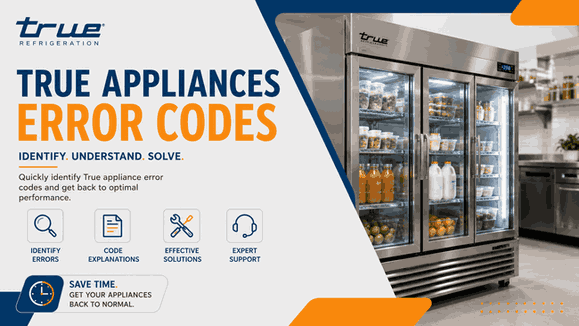
A True error code usually makes the most sense when it is connected to the way the equipment is actually holding temperature. The display may show only a short warning, but the real problem often appears in day-to-day operation. A commercial refrigerator may start running warm, recover more slowly, or keep showing cabinet alarms. A merchandiser may stay on while product temperature or display-case stability becomes less dependable during business hours.
For customers in San Jose and across the Bay Area, these alerts are best understood as commercial refrigeration warnings tied to real operating performance, not final diagnoses. In many cases, the code does not identify one exact failed part by itself. Instead, it points to the function that is losing stability. That may involve temperature control, sensor feedback, condenser condition, voltage response, door status, communication, or refrigerant-related performance.
Many refrigeration problems begin before the unit fully stops cooling. Equipment may still be running, but holding conditions or recovery speed are already changing. That is often when repeated alerts begin appearing.
A one-time code can sometimes follow a short interruption. A warning that keeps returning usually means more. In practical commercial use, repeated True alerts often fall into a few larger patterns: temperature instability, sensor and probe faults, condenser warnings, voltage alarms, door-open issues, and communication-related errors. Once the same message keeps coming back, the main question becomes whether the unit can still protect product the way the business needs it to.
For True refrigerators, one of the most important groups is:
1-1 / HI / LO / Hi / Lo / HA / LA
These alerts usually point to temperatures moving too high or too low for normal operation. In commercial use, that may show up as unstable product temperature, weak cooling recovery, or holding conditions that need quick attention.
Voltage alarm codes: 1-2 / uHi / uLi / uLo / Ulo / UHi
Condenser alarm codes: 1-3 / Con
Sensor and probe error codes: 2-1 / E0 / E1 / E2 / E01 / E02 / E03 / E04 / P1 / P2 / P3
Potentiometer-related codes: 2-2 / E6
Leakage and refrigerant alarm codes: 3-1 / LEA
Door-open alarm codes: dOr / dor / dA / do
Defrost-related code: Ed
Communication and display-related codes: EoC / E13 / non / SYn
Compressor and heater fault codes: E4 / E5
Memory, external, and pressure alarm codes: EE / EAL / BAL / PAL
What makes these warnings important is the effect on product holding. Even if the cabinet still feels partly cold, repeated temperature, condenser, or probe alarms often show that refrigeration performance is already becoming less dependable.
For True merchandisers, the main family here is:
do / hi / Lo / E1 / E2 / E3
These alerts usually point to an open-door condition, temperature moving outside the normal range, or a failed probe. In daily commercial use, that may show up as warming product, unstable case temperature, or inconsistent operation during business hours.
Health safety alarm / lockout codes: hLA / Loc
Power failure code: PF
These warnings matter because merchandisers depend on visible, stable cooling. Once door alarms, probe faults, or temperature warnings keep returning, the problem is already affecting both product condition and normal display performance.
The best first step is to compare the code with what the equipment is actually doing.
If cabinet temperature is rising, if the unit is recovering too slowly, if door alarms keep appearing, or if sensor, condenser, or voltage warnings are repeating, the equipment is already showing the real context behind the alert.
A repeated True warning usually means more than a brief interruption. It often shows that one of the refrigeration system’s key functions is losing stability and that normal commercial use is already being affected.
True error codes are most useful when they are treated as early signs of changing refrigeration dependability. They may not identify the exact failed component by themselves, but they often show which function is under stress and whether the unit can still be trusted in real operation.
For customers in San Jose and throughout the Bay Area, professional commercial service can help connect the recurring code to the actual symptom, identify why the warning keeps returning, and determine the next repair step.
📍 Address: 919 S Winchester Blvd, San Jose, CA 95128
📧 Email: office@bestechrepair.com
☎️ Phone: (408) 906-8668
This True commercial error code table organizes each True fault code by equipment type, listed meaning, initial check, technician service note, and related help when available. It includes True commercial refrigerators, freezers, coolers, merchandisers, prep units, and undercounter refrigeration equipment, so each display message can be matched with the correct table row and reviewed with True’s official Service and Installation Manuals and Technical Support resources.
| Error Code | Appliance | Meaning | Safe first steps | Technician required | Related help |
|---|---|---|---|---|---|
| 1-3 | Commercial Refrigeration | Condenser alarm. | Clean the condenser coil, verify the condenser fan runs and pulls air through the coil, and confirm the unit has proper external clearance. | Yes — if condenser airflow is correct and the alarm persists. | True Commercial Refrigeration Door Open High Temp and Condenser Alarm Problems |
| 2-1 | Commercial Refrigeration | Sensor error. | Disconnect and reconnect the probe harness, measure probe resistance with the probe unplugged from the controller, and compare the reading to the official chart. | Yes — if the probe tests bad or wiring damage is found. | |
| Ed | Commercial Refrigeration | Defrost ended by maximum defrost time. | Inspect frost buildup, verify heater operation where applicable, check evaporator fan operation, and confirm defrost-probe feedback is reasonable. | Yes — if the unit repeatedly fails to terminate defrost correctly. | |
| HI | Commercial Refrigeration | High temperature alarm. | Check product temperature, condenser cleanliness, door sealing, fan operation, airflow inside the cabinet, and recent loading conditions. | Yes — if the cabinet does not recover after those checks. | |
| LEA | Commercial Refrigeration | Refrigerant leakage alarm. | Inspect for visible oil residue, abnormal frost pattern, and obvious tubing damage, then continue with refrigeration-system diagnostics. | Yes — sealed-system work is typically required. | True Commercial Refrigeration Line Voltage Communication and Refrigerant Leakage Alarms |
| Lo | Commercial Refrigeration | Low temperature alarm. | Verify actual product temperature, review set point, and inspect probes and control cycling before changing components. | Yes — if low-temperature operation continues after those checks. | |
| Ulo | Commercial Refrigeration | Low supply voltage. | Measure incoming voltage and correct low line voltage or excessive voltage drop before replacing controls. | Yes — if the supply is stable and the fault still returns. | |
| UHi | Commercial Refrigeration | High supply voltage. | Measure incoming voltage and correct overvoltage conditions before replacing controls. | Yes — if measured voltage is within spec and the code remains. | |
| BAL | Commercial Refrigeration | Serious external alarm. | Inspect the external safety/alarm input and determine what upstream device is holding the alarm active. | Yes — this typically requires system-level diagnosis. | |
| PAL | Commercial Refrigeration | Pressure switch alarm. | Check the pressure-switch circuit, condenser condition, and airflow before moving to full refrigeration-system diagnostics. | Yes — if the pressure-switch condition does not clear promptly. | |
| do | Commercial Refrigeration | Door open alarm. | Close the door fully, verify gasket seal, and inspect door alignment or self-closing action. | Yes — if the controller still reads the door as open with the door shut. | |
| hi | Commercial Refrigeration | High temperature alarm. | Check actual cabinet temperature, condenser cleanliness, airflow, fan operation, and door sealing. | Yes — if the cabinet does not recover after those checks. |
Read reviews about our repair, installation and maintenance services. Our trained experts are always ready to help. To schedule your next appointment, give us a call or complete our online form.

Leave your contact details for communication with the operator, indicate a convenient date for yourself and our operators will contact you or call us: