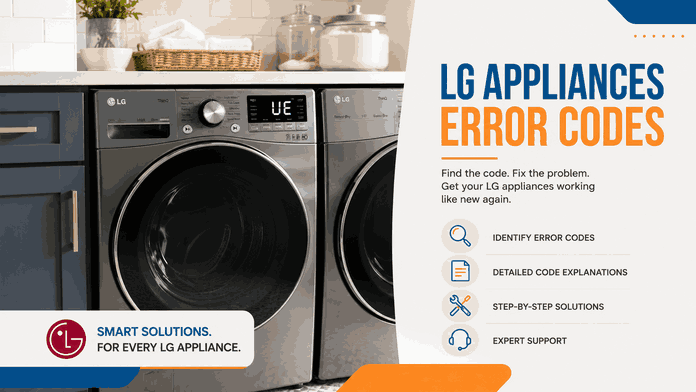
An LG error code is usually most useful when it is connected to the way the appliance is actually performing. The display may show only a short warning, but the real issue often appears through daily use. A washer may stop before finishing. A dryer may run without drying properly. A dishwasher may lock out operation. A refrigerator may stay on while cooling becomes less dependable. A range, cooktop, or microwave may still power on but stop responding normally.
For homeowners in San Jose and across the Bay Area, these alerts are best read as system warnings tied to real appliance behavior, not final diagnoses. In many cases, the code does not identify one exact failed part by itself. Instead, it points to the function that is losing stability. That may involve draining, motor operation, locking, sensing, heating, cooling, or control communication.
Many LG appliances begin showing problems before they fully stop. The unit may still run part of the cycle, but reliability is already changing. That is often when repeated alerts begin appearing.
A one-time code can sometimes follow a brief interruption. A code that keeps returning usually means more. In practical home use, repeated LG warnings often fall into a few larger patterns: water movement problems, motor or rotation trouble, cooling instability, heat-related faults, and electronic control issues. Once the same message keeps coming back, the bigger question is whether the appliance can still be trusted to work normally.
For LG front load washers, one of the main groups is:
OE / E03 / E21 / dE / dE1 / E01 / dE2 / E30 / FE / E04 / E12 / PE
These alerts usually point to drain problems, door-lock issues, overfill conditions, or water-level sensing faults. In real use, that may mean water left in the drum, a cycle that will not start, or a washer that stops before completion.
Motor and tub-rotation codes: LE / CE
Power failure code: PF
Heating and dry-function codes: tE / dHE
For LG top load washers, the main family is:
AE / LE / LE1 / dE / dL / PE / FE / E3
These warnings usually point to motor or rotation issues, lid problems, pressure-sensor trouble, overfill conditions, or drain-motor-related faults.
Temperature and vibration sensor codes: tE / vS / u5 / uS
Freeze and voltage-related codes: FF / PS
Control and clutch-related codes: EE / E6
For LG dryers, the main code family is:
LE1 / LE2 / AE / CE1 / LE3 / EHE / ELE / HS / tE1 / tE2 / tE3 / gAS
These alerts usually point to motor faults, air-circulation issues, sensor failures, overheating conditions, thermistor trouble, or gas-supply-related problems. In home use, that may show up as a dryer that runs without drying correctly, stops too early, or cannot turn the drum normally.
What links these laundry warnings together is the loss of normal cycle flow. The appliance may still turn on, but it may no longer drain, lock, rotate, sense, or heat the way it should.
For LG dishwashers, one of the most important groups is:
AE / E1 / LE / CE / FE
These alerts often stop the machine from operating normally. They usually point to a leak condition, motor problem, or too much water inside the tub. In daily use, that may look like a dishwasher that refuses to start, stops repeatedly, or shuts down to protect the system.
Continuous-run test mode code: CR
Heater error code: HE
Spray-arm motor code: nE
Thermal and thermistor code: tE
For LG refrigerators, the central family is:
CH E / E CH / CL E / E CL / CF / dH / dS / F dS / r dS / rF / ER(E) rF
These alerts usually point to fan problems, defrost failure, sensor trouble, airflow issues, or broader cooling instability. In home use, that may show up as weak cooling, temperature swings, frost buildup, or food storage conditions that no longer feel reliable.
Compressor and communication codes: 33 / 22 / CO / C1 / Od
Ice-maker related codes: IS / 1S / iT
Door and auto-door system codes: 67 / Ad / AS / L AS / r AS / dr
Temperature sensor codes: rS / rT / SS
These alerts usually matter quickly because one affects cleanup and the other affects food protection. Once performance starts slipping, the code becomes more than a display message.
For LG ranges and cooktops, the main group is:
F1 / F2 / F4 / F5 / F7 / F9 / F10 / F11 / F19 / F22
These warnings usually point to thermistor trouble, heating faults, fan issues, door-lock problems, steam-sensor trouble, or electronic communication faults.
Another range or cooktop warning may include:
PF
For LG microwaves, the main family is:
E10 / F1 / F2 / F3 / F4 / F5 / F11 / F13 / F14 / F15 / F16 / F17 / F19 / DOOR
These alerts usually point to control-board faults, thermistor problems, touch-panel issues, sensor failures, inverter communication trouble, voltage irregularities, heating faults, or door-latch problems.
What makes these cooking-appliance warnings important is the loss of predictability. The appliance may still have power, but once controls, sensors, or heating behavior become unstable, normal use becomes harder to trust.
The best first step is to compare the code with what the appliance is actually doing.
If the washer is not draining, the dryer is not heating, the dishwasher is stopping repeatedly, the refrigerator is losing stable cooling, or the cooking appliance is beeping, overheating, or rejecting commands, the appliance is already showing the real context behind the warning.
A repeated LG alert usually means more than a brief interruption. It often shows that one of the appliance’s key systems is losing stability.
LG error codes are most useful when they are treated as early signs of changing appliance dependability. They may not identify the exact failed component by themselves, but they often show which function is under stress and whether the appliance can still be trusted in everyday use.
For customers in San Jose and throughout the Bay Area, professional in-home service can help connect the recurring code to the symptom the appliance is actually showing, identify why the warning keeps returning, and determine the next repair step.
📍 Address: 919 S Winchester Blvd, San Jose, CA 95128
📧 Email: office@bestechrepair.com
☎️ Phone: (408) 906-8668
This LG appliance error code table organizes each LG fault code by appliance type, listed meaning, initial check, technician service note, and related help when available. It includes LG refrigerator, front load washer, top load washer, dryer, dishwasher, range, cooktop, and microwave error codes, so each display message can be matched with the correct table row and reviewed with LG’s official Washer Error Code List, Refrigerator Error Code List, or main LG Support Center.
| Error Code | Appliance | Meaning | Safe first steps | Technician required | Related help |
|---|---|---|---|---|---|
| 22 / 33 | Refrigerator | Compressor-relay problem. | No official owner troubleshooting steps published by LG. | Yes — service required. | |
| CH E / E CH | Refrigerator | High-side refrigerant leak (likely condenser-side leak). | No official owner troubleshooting steps published by LG. | Yes — service required. | |
| CL E / E CL | Refrigerator | Low-side refrigerant leak (likely evaporator-side leak). | No official owner troubleshooting steps published by LG. | Yes — service required. | |
| PE | Front Load Washer | Water level sensor malfunction. | Unplug for 10 seconds, reconnect, and restart the cycle. | Yes — if the code persists. | |
| PF | Front Load Washer | Power failure during the cycle. | Power-reset the washer, then restore power and retest. | Yes — if the code persists. | |
| FE | Top Load Washer | Overfill detected. | Unplug, reconnect, and retry; if the tub continues filling, stop use. | Yes — if the error returns or the tub keeps overfilling. | |
| E3 | Top Load Washer | Drain motor operation error. | Power-reset the washer and retry; thaw the washer if freezing conditions caused the fault. | Yes — if the error repeats or is unrelated to freezing. | |
| FO | Dryer | Lint filter not inserted properly. | Remove and reinsert the lint filter correctly. | Yes — if the error continues. | |
| HS | Dryer | Humidity-sensor error. | Clean and dry the sensor bars below the lint filter, then retry. | Yes — if the error persists. | |
| PF | Dryer | Power-failure code. | Perform a power reset and restart the dryer. | Yes — if the error persists. | |
| HE | Dishwasher | Heater error; water did not heat properly or overheated. | Power the unit off, cycle the breaker for 10 seconds, restore power, and retry. | Yes — if the code persists. | |
| nE | Dishwasher | Vario motor issue affecting the spray arms. | Restart the dishwasher after a full power reset. | Yes — if the code persists. | |
| F27 | Ranges and Cooktops | Cooling fan stalled or locked during Self Clean. | Power-cycle the breaker for 30 seconds, then retry. | Yes — if the code returns. | |
| F33 | Ranges and Cooktops | Front induction burner temperature-sensor error. | Power-cycle the breaker for 30 seconds, then retry. | Yes — if the code returns. | |
| F45 | Ranges and Cooktops | Fan error. | Power-cycle the breaker for 30 seconds, then retry. | Yes — if the code returns. | |
| F1 | Microwave | Mainboard problem. | No official owner fix beyond requesting service. | Yes — service required. | |
| F2 | Microwave | Thermistor problem causing out-of-range temperature. | No official owner fix beyond requesting service. | Yes — service required. |
Read reviews about our repair, installation and maintenance services. Our trained experts are always ready to help. To schedule your next appointment, give us a call or complete our online form.

Leave your contact details for communication with the operator, indicate a convenient date for yourself and our operators will contact you or call us: